
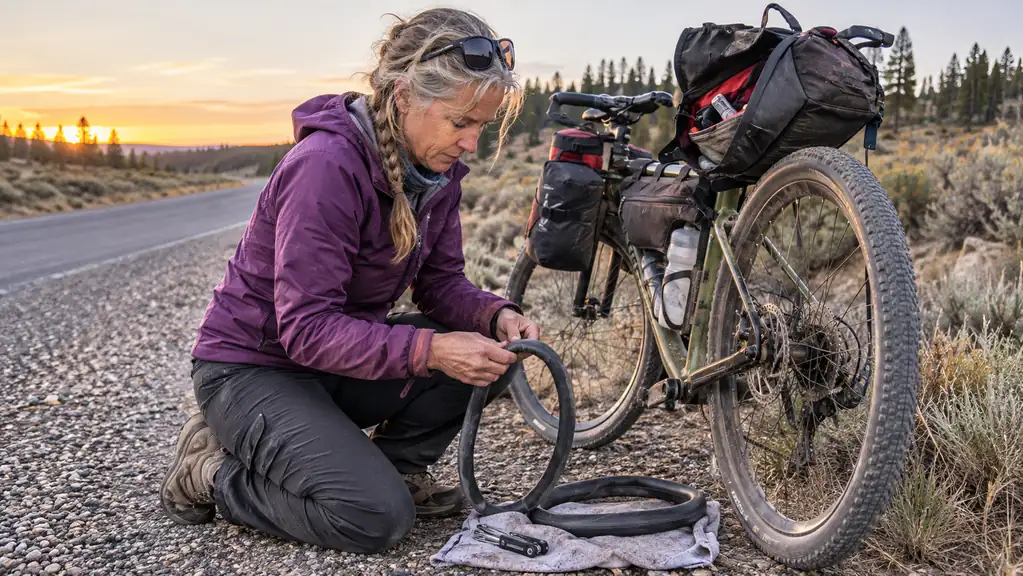
Almost every review of the Crankbrothers M19 opens with the same list. Nineteen functions. Chromoly steel. 175 grams. Lifetime warranty. Every one of those things is true, and none of them is the part that matters when you are kneeling on a gravel shoulder at mile 58 with the wind coming out of the west and a chain hanging loose.
I am 67 years old, I live in Prescott, Arizona, and I ride 50 to 70 miles about twice a week from spring through fall, with a fair amount of climbing because the town sits around 5,400 feet. Two and a half years ago a long ride went badly enough that I decided to stop carrying a loose handful of Allen keys in my seat bag and get something proper. In the first week of March after that ride, I bought the M19 from Crankbrothers. It has been in that bag ever since, through roughly 8,000 miles. Here is the honest version: what earned its place, what annoys me, and who should buy something else.
The Quick Verdict
A well-made, genuinely useful 175 grams of steel that will outlast most bikes it rides on. It is a roadside repair kit, not a workshop, and the chain tool wants patience and warm hands.
Amazon Check Today's Price →Nineteen functions, one lump of steel, two years in my seat bag
This is the piece of my kit I have never once thought about replacing. If you want the same tool in your bag, here is where to look.
Amazon Check Today's Price on Amazon →What the M19 Actually Is
The M19 is a fold-out multi tool built on a centre drive pivot, made from chromium-molybdenum steel, listed at 175 grams, and folding to about 3.5 by 2 by 0.5 inches. Crankbrothers backs it with a lifetime warranty, which for a lump of steel that lives in a seat bag is an easy promise to keep. The functions are the usual long list: hex keys in 2, 2.5, 3, 4, 5, 6 and 8 millimeter, spoke wrenches in sizes 0 through 3, Phillips screwdrivers in #1 and #2, a flat #2, open wrenches at 8 and 10 millimeter, Torx bits, and a chain tool rated for 8 through 12 speed chains.
My bike is a steel touring frame with a 9 speed drivetrain, rim brakes, and 32 millimeter tires with tubes and Presta valves. That puts me squarely in the middle of what the M19 covers. Every fastener I can reach with a hex key on that bike is a 4, 5 or 6 millimeter, and the tool has all three, plus the 2, 2.5 and 8 for the things I do not touch often. The 8 millimeter is there for pedals, and I have used it once at the bench rather than on the road.
What it is not is a substitute for a bench. Crankbrothers packed functions in rather than leverage. The arms are short because the tool has to fold into something you will actually carry, and short arms mean you will work harder on a stubborn bolt than you would with the long key hanging on the garage wall. I have never rounded a bolt with it. I have also never pretended it was the right tool for a bottom bracket, and neither should you.
The part that surprised me is the body. The side grips give you a real handhold even with gloves on, which matters from November through March here, and the centre drive pivot means the arms swing out from the middle rather than from one end. That makes the tool sit better in the hand when you are pushing on a tight bolt. It is a small thing until you are the one pushing.
How I've Used It
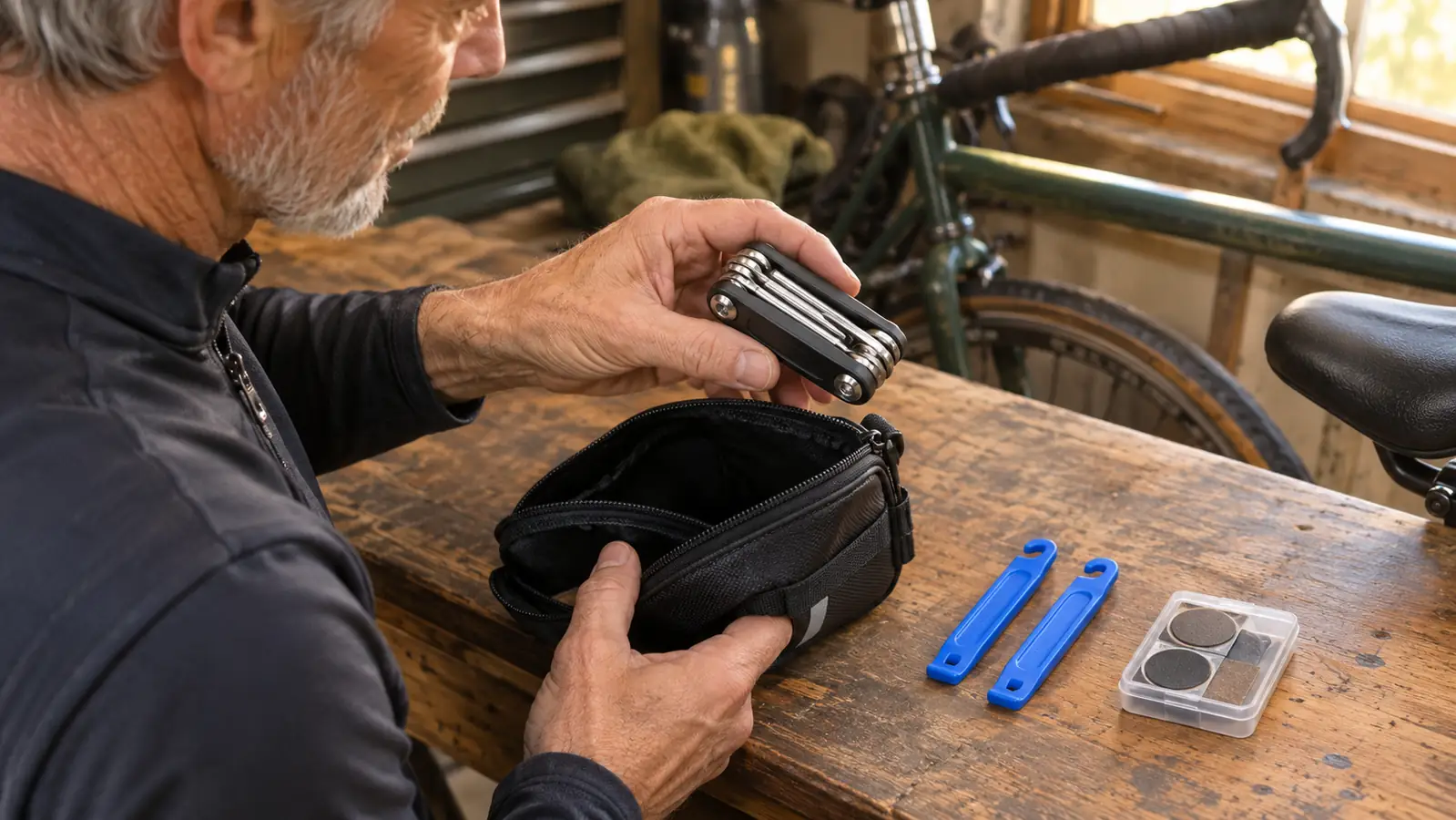
In two years and roughly 8,000 miles, the M19 has come out of the bag maybe a dozen times. Most of those were small. A saddle that crept down half an inch over a long day. A bottle cage bolt that went loose on chip seal. A stem faceplate that needed a quarter turn after a rough stretch of road south of Chino Valley. The 5 millimeter hex is the one I reach for most, and the 4 is close behind.
The spoke wrench has done real work. I run about 60 psi in the front tire and 65 in the rear and I check them before every ride, but low pressure does not save a spoke. I have had two nipples work loose on the rear wheel over the years, and both times the M19 got the wheel straight enough to ride home at a sensible pace instead of a wobble.
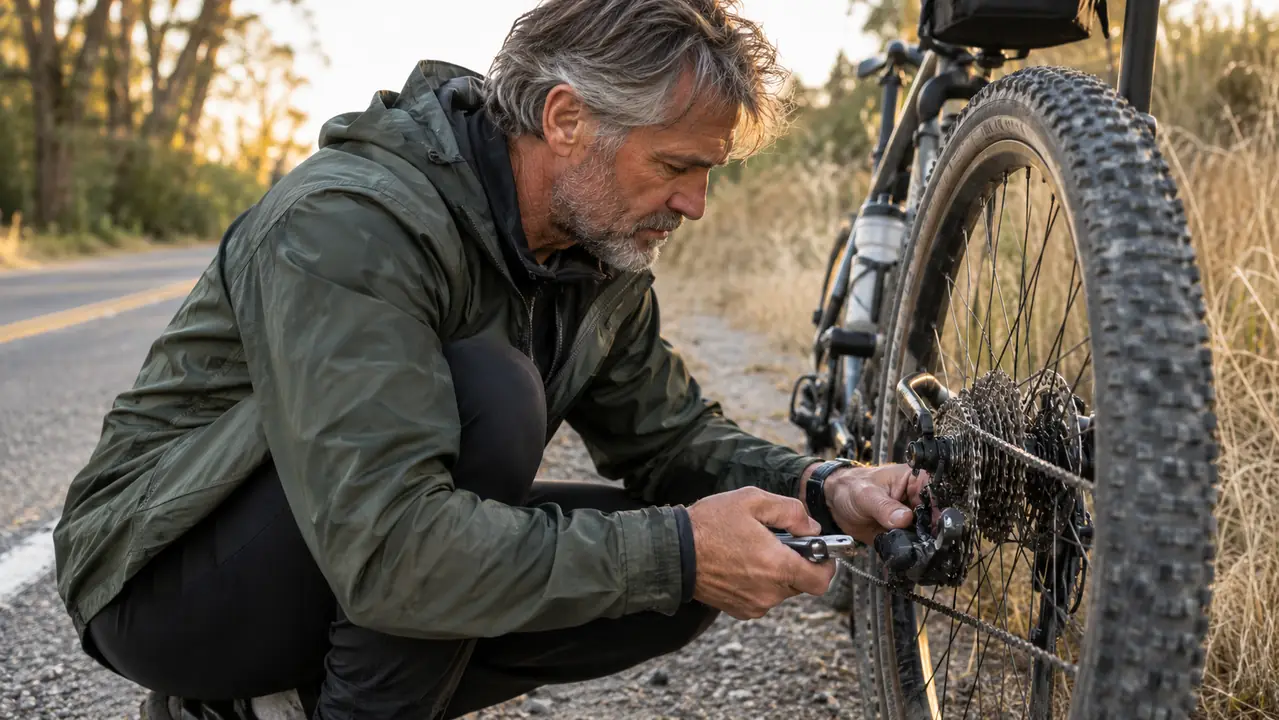
The chain tool has been used on the road exactly once. That is the honest number. One broken chain in 8,000 miles, on a cool morning in April, and the tool did the job. It also took me about ten minutes, most of it spent seating the chain in the cradle while my fingers were stiff. I was glad of the side grips before it was over.
The screwdrivers and the open wrenches have been used at the bench more than on the road, and that is fine. A multi tool earns its keep on the two or three functions you need in bad weather, not on the nineteen printed on the package. I would rather carry three functions that work than nineteen that look impressive on a spec sheet.
One routine worth mentioning, because it is where the tool spends most of its life. When I get back from a long day I open the seat bag on the bench and put the M19 on the rag next to the spare tube and the patch kit. I wipe it down, open it once, and close it. That takes about a minute and it means I know the state of my kit before the next ride rather than during it.
What I Liked
- 175 grams of chromoly steel that has not rusted, loosened or shed a function in two years
- Hex keys from 2 through 8 millimeter cover every fastener on a 9 speed touring bike
- The chain tool handles 8 through 12 speed chains and has rescued one ride
- Side grips give a real handhold with gloves on
- Lifetime warranty from Crankbrothers
Where It Falls Short
- No tire levers and no pliers, so you carry those separately
- Chunky enough that it lives in the seat bag, not a jersey pocket
- The chain tool is fiddly with cold or tired hands
- Short arms mean limited leverage on a stubborn bolt
The Chain Tool Is the Part Nobody Warns You About
Here is what the packaging does not say. The chain tool is the reason to buy this tool, and it is also the part most likely to make you mutter. On a bench with warm hands and good light it is fine. On a shoulder, with the chain greasy and your fingers cold, seating the link in the cradle takes more dexterity than everything else on the tool combined.
Practise at home first. That is the advice I would give anyone, and it is the advice I gave myself after that April morning. Break a chain and rejoin it in your garage on a Saturday where nothing is at stake, and you will learn how much travel the pin needs and how the cradle holds the link. Doing it for the first time on the roadside is a poor introduction to an otherwise good tool.
A dozen roadside jobs in two years. One of them was a broken chain. That is the one that earned this tool its place in my bag.
What Two Years and 8,000 Miles Did to It
Wear is where a multi tool tells the truth. The hex ends on mine still fit their bolts snugly. None have rounded, which is more than I can say for the loose keys I carried before, whose 5 millimeter had gone soft enough to slip on a derailleur clamp bolt and chew the head.
The folding action is still firm. There is a little more play in the pivots than the day I opened it, which is normal for anything with that many joints, but nothing flops open in the bag. The steel has picked up scuffs from living next to a spare tube and a patch kit, and one corner of the body has a shiny spot where it rubs. No rust, and I ride in the rain sometimes.
The Phillips #1 is the function I have used least and it looks it. The spoke wrenches show a little polishing on the sizes I actually use. The chain tool pin is still straight. If I am honest, the tool looks about the same as it did in the first month, which is the highest compliment I can pay a piece of steel.
What I Stopped Worrying About
Two years in, I have stopped worrying about two things. The first is the pivots loosening. They have a little play and they have had it for a while now, and nothing has come apart or flopped open inside the bag. The second is the finish. The body has scuffs and a shiny corner, and none of that has anything to do with whether the 5 millimeter fits a bolt.
I have also stopped carrying a backup key. For the first few months I kept one loose 5 millimeter in the bag in case the folding tool let me down. It never did. That key went back to the bench and I have not missed it, which is about as clear a verdict as I can give after two years.
The Weight Question
175 grams is not nothing. It is about the weight of a spare tube and a half, and if you count grams you already know that. My view, and it is the view of a man who is 67 and not racing anybody, is that weight is the wrong thing to worry about here. A tool that is light and cannot break a chain is dead weight in the bag.
If you want lighter, you trade functions. Crankbrothers makes smaller tools in the same family, and they are good tools for the rider who only needs a hex key and a screwdriver. Ed, my riding partner, carries a Park Tool IB-2 fold-up set that is a different animal entirely, and we have compared the two on his tailgate more than once. His is well made. Mine has a chain tool and his does not, and for a rider doing 60 mile days an hour away from the truck, that settles it.
The other thing about weight is where it sits. A tool in a seat bag is weight you do not feel. A tool in a jersey pocket is weight you feel every time you stand on a climb. Mine has been in the bag for two years and most days I could not tell you it was there.
There is one more consideration, and it is about hands rather than weight. Any small tool is harder to work when your grip is tired or the morning is cold. The side grips help. They do not turn a fiddly job into an easy one. If your hands are the weak link in your kit, that is worth knowing before you are kneeling on gravel.
What It Does Not Have
No tire levers. No pliers. Those are the two gaps, and they are worth saying plainly because a function count inflates a reputation. Nineteen functions sounds like everything. It is not everything. I still carry two plastic tire levers and a patch kit, and I would want a plug kit in the bag if I ever went tubeless.
The folded size is listed at about 3.5 by 2 by 0.5 inches, and in practice that is a lump. It does not sit in a jersey pocket comfortably next to a phone. Mine lives in the seat bag and comes out when it is needed, which is the right home for it. If you carry everything in your pockets, this is a tool that will annoy you.
The warranty is worth a mention only because Crankbrothers lists it as lifetime. I have not needed it. The steel has not failed, the pins have not bent, and nothing has snapped. A warranty you never use is the best kind, and the fact that it is there tells you something about how the thing is put together.
Who This Is For
This tool suits a rider who does long days away from home and wants one compact piece of steel that covers the fasteners on the bike plus the one failure that ends a ride. If you run 8 through 12 speed and your bike is built from standard hex hardware, the M19 covers you. It suits riders who will practise with the chain tool in the garage before they need it on a shoulder. And it suits anyone who, like me, got tired of digging through a seat bag for the one Allen key that had worked its way to the bottom.
Who Should Skip It
Skip it if you want something smaller and lighter in a jersey pocket and you have no use for a chain tool. Skip it if you already carry a fold-up set with levers built in, because the M19 duplicates most of what you have and adds a lump. And skip it if you are not going to learn the chain tool. A chain tool you cannot work is dead weight with a nice finish.
One more thing, since I am 67 and my hands are not what they were at 40. If arthritis has your hands, try a folding tool in a shop before you buy one, or plan to let a riding partner do the fixing. That is not a knock on the M19. It is a knock on small tools in general, and on getting older. My own hands ache after a long day, and I have learned to do the fiddly work early in a ride rather than at the end of one.
One tool, one seat bag, one less thing to think about
The M19 has been in my bag for two years and roughly 8,000 miles, and I have not once considered replacing it. If that is the kind of kit you want, here is the current price.
Amazon Check Today's Price on Amazon →