
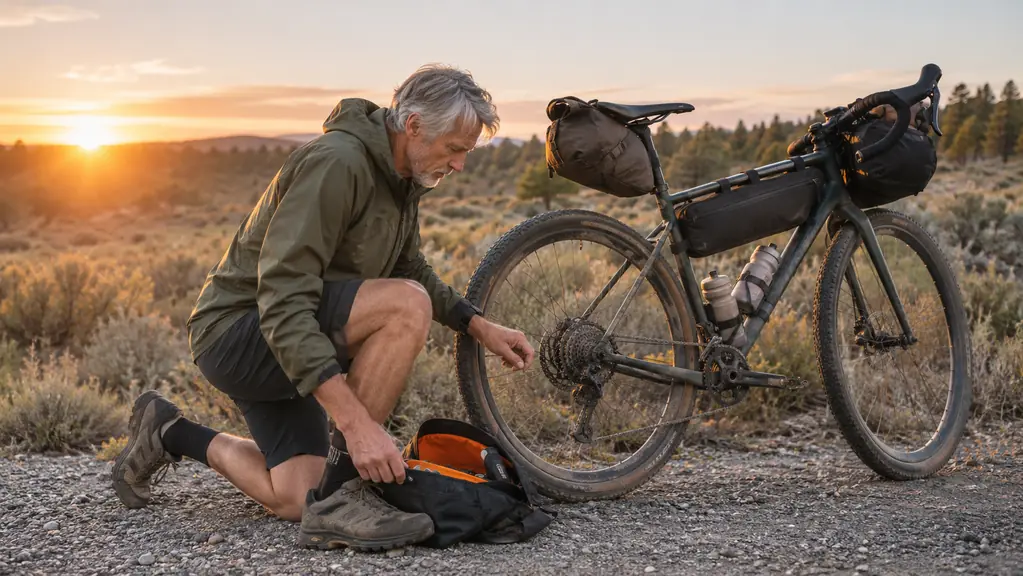
The ride that taught me to carry a real tool was 80 miles long, and it ended with me squatting in the gravel on a county road north of Chino Valley trying to get a flat fixed with a pocket full of loose Allen keys. I had no chain tool. I had no plan. I got home after dark, sore in the lower back, grease on my hands, and a wrong turn on my conscience. I was 65 then. I am 67 now, and that day is still the reason my seat bag looks the way it does.
What replaced the loose keys is the Crankbrothers M19. It is a folding multi-tool in chromoly steel, 175 grams, about 3.5 by 2 by 0.5 inches folded, and it lives in my seat bag beside one spare tube, a patch kit and two plastic tire levers. It carries hex wrenches in 2, 2.5, 3, 4, 5, 6 and 8 mm, spoke wrenches in four sizes, Phillips and flat screwdrivers, 8 and 10 mm open wrenches, Torx bits, and a chain tool rated for 8 to 12 speed chains. My bike is a 9 speed, so the chain tool fits. That last sentence is the only one that matters when you are standing on a shoulder.
One tool, 175 grams, and no more walking home
The M19 covers every fastener on my steel touring bike plus a chain tool for 8 to 12 speed. It has ridden about 8,000 miles in my seat bag and it has never been the reason a ride ended early.
Amazon Check Today's Price on Amazon →Step 1: Match the Tool to the Bike You Actually Ride
Before you buy any multi-tool, empty your seat bag onto the bench and list what your bike genuinely needs. Mine needs a 4, a 5 and a 6 mm hex more than anything else, because those cover the stem faceplate, the seatpost clamp and the rack bolts. The 2 and 2.5 mm sizes I have never touched on the road. They are there for derailleur limit screws if the day ever calls for them, and I would rather have them and not need them than the other way around.
The 8 mm hex earns its keep on a different kind of bike than mine. On mine it mostly sits. The 8 and 10 mm open wrenches are the same story, weightless until you own something with those fasteners. If you ride a newer bike with Torx heads on the brake hardware, the Torx bits are the reason the Crankbrothers tool stays in the bag. Count the fastener types on your own bike, not the ones on the bike in the catalog photo. That is a ten minute job at the bench and it saves you from buying twice.
The side grips matter more than the spec sheet suggests. I wear full finger gloves from about October through April up here at 5,400 feet, and a folding tool with smooth edges turns into a bar of soap in cold hands. The textured side panels give me something to hold when my fingers are stiff at 40 degrees. That is not a feature I would have thought to look for at 30. It is the first thing I notice now.
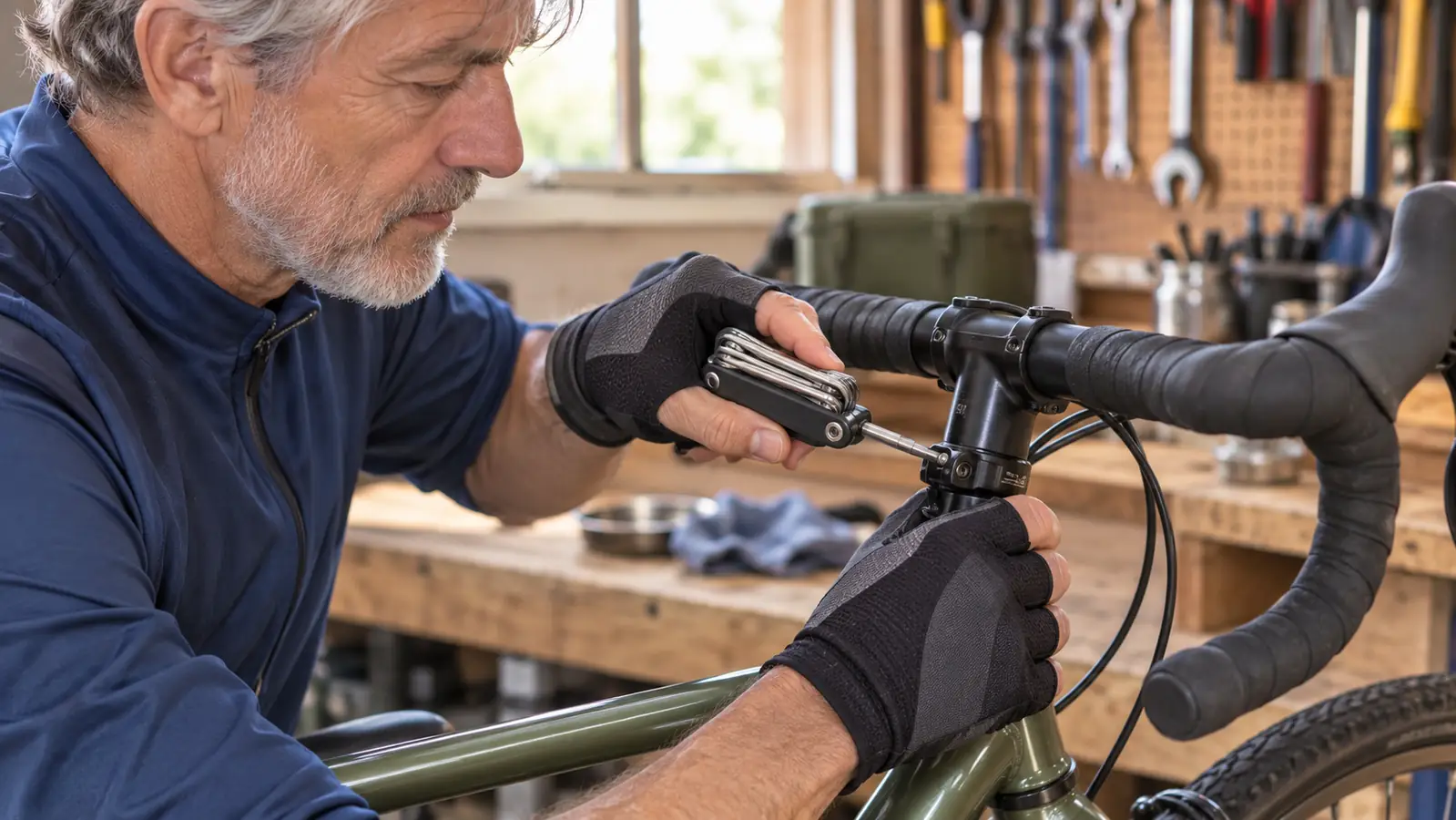
Step 2: Practice the Chain Tool at the Bench, Not on the Shoulder
You will not learn a chain tool on the side of the road with cold hands and a car passing every ninety seconds. Learn it in the garage, on a scrap of old chain, on a Tuesday, with coffee going cold on the bench. Push a pin out. Push it back in. Do that four times. Your hands remember the thread and the feel long after your memory of the instructions has gone.
In about 8,000 miles I have used the chain tool on the road exactly once. A quick link let go on a climb out of the valley and the chain was on the ground before I understood what the noise was. The repair took me eleven minutes, most of it spent finding a clean place to kneel. That is the whole return on the weight of the tool. One repair. I would still carry it.
Two honest notes. The chain tool is fiddly with cold hands, because the lever is short and you are asking a lot of a small handle. And the M19 has no pliers and no tire levers. It will not open a stubborn quick link the way a real pair of pliers will, and it will not lift a tire off a rim. I carry two plastic levers for that job and I have never once regretted the extra ounce.
I have used the 5 mm hex about two hundred times.
Step 3: Learn the Five Fasteners You Touch Most
Once you are home, open the tool and put the right bit on every bolt you can reach. Do not tighten anything. Just learn which size lives where. The stem faceplate, the seatpost clamp, the rack bolts and the bottle cage bolts are what loosen on a long day. Knowing the seatpost clamp is a 5 means you fix it in fifteen seconds instead of guessing in the dark with a headlamp in your teeth.
Saddle height is the adjustment worth marking. My left knee complains on steep climbs, and a post that has slid down a quarter inch makes it complain a good deal louder by mile forty. When I set height at the bench I wrap a strip of tape on the post as a reference. On the road the M19 loosens the clamp, I raise the post back to the tape, and I snug it. That is a two minute repair that rescues the last thirty miles of a day.
The screwdrivers get used more than you would guess. Phillips in two sizes and a flat blade, all small. They are for limit screws and for the little pieces that rattle loose, and they are not for prying anything at all. A small flat blade is a tempting pry bar. Resist it. The tip folds over and then it is useless for the job it was actually made to do.
Step 4: Carry What the Tool Does Not Cover
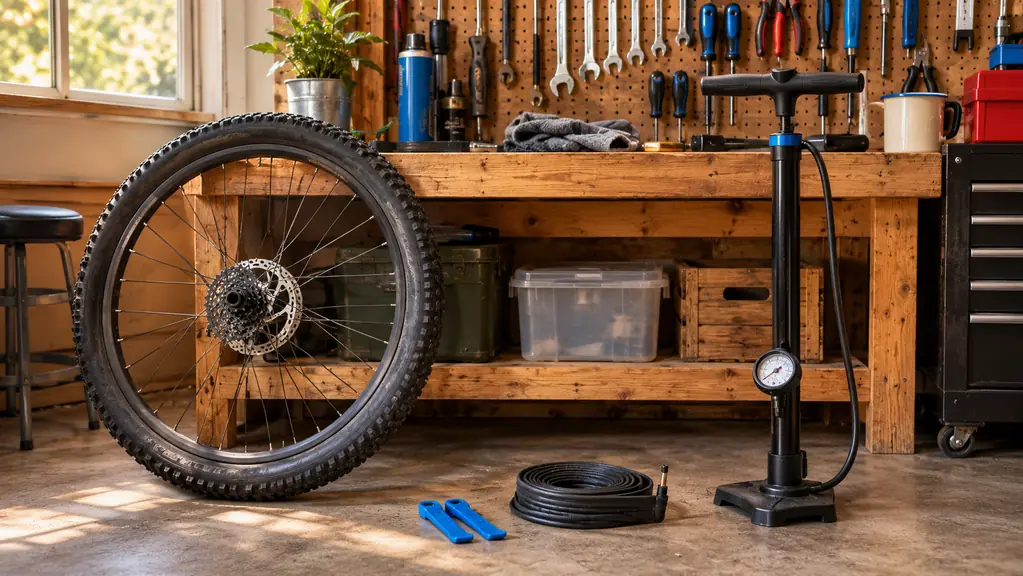
The Crankbrothers M19 is one part of a kit, not the kit. Mine holds a spare tube sized for 32 mm tires, a patch kit and two plastic levers. My valves are Presta and the pump at home fits them, so the tube goes in with the valve already checked. I run about 60 psi in front and 65 in back, and I check both before every ride so a soft tire is never a surprise twenty miles out.
The spare tube is the piece people skip. I know riders who carry patches and no tube, and I know how that goes on a cold morning when the glue is stiff and your hands are shaking. A tube is faster. The patch kit is for the second flat, which is the one that decides whether your day ends early. I have had two flats on one ride once in five years. Once was enough to make the kit permanent.
Weight is worth talking about plainly. The tool is 175 grams. The tube, the levers and the patch kit together weigh more than the tool does. If you count grams, count all of them honestly. A rider who leaves the tube at home to save four ounces and then walks six miles has made a bad trade. I have made that trade. I do not recommend it.
Step 5: Set the Stop Rule Before You Need It
The most useful thing in my seat bag is a rule I set at the bench: if a repair runs past twenty minutes on the shoulder, or if it needs a tool I do not have, I stop and call Beth in Tucson or flag a ride. I have used that rule twice. Both times it was right, and both times I felt foolish for about a mile and then fine.
This is not a race and I am 67 years old, riding alone a fair amount of the time. A half fixed brake or a wheel with three loose spokes is not a puzzle to be solved by stubbornness on a road with no shoulder. The spoke wrenches on the M19 will bring a wobbly wheel straight enough to roll home at a walking pace. They will not rebuild a wheel. That difference is your front teeth.
If your body starts talking, that counts as a stop too. Hands going numb, a knee that will not track, a back that seizes at mile fifty. Fix the bike, then get off it. If it does not clear up in a couple of days, see your doctor. My left knee has complained for five years and I have learned to listen to it earlier than I used to.
What Else Helps
A floor pump with a working gauge changed my riding more than any tool in the bag. For years I guessed pressure by squeezing the tire, which is not a measurement, it is a hope. The pump at my bench has a 3 inch analog gauge and a head that fits Presta and Schrader, and I top up before every ride. Sixty front, sixty five rear, on 32 mm tires. That is my setting, not a rule for you. A rider who outweighs me by forty pounds will want more.
Ed, my riding partner, carries a Park Tool IB-2 fold up set and has for years. It is a good tool and it has gotten us out of a spot or two. I have never owned one, so I will not pretend to review it. What I will say is that we run different kits and neither of us has ever been stranded because of the choice. The kit matters less than knowing how to use it before you need it. Crankbrothers backs the M19 with a lifetime warranty, which is a fair signal about the steel, but the warranty does not turn a bolt for you.
The other thing that helps is a route you looked at the night before. I plan on the computer and send it to the unit on my bars. That has saved me from more wrong turns than any tool has saved me from mechanicals. It is not what this piece is about. It is just true.
The tool lives in the bag so the walk does not happen
Chromoly steel, 175 grams, hex from 2 to 8 mm, spoke wrenches, screwdrivers, open wrenches, Torx bits and a chain tool for 8 to 12 speed. Pack the tube and the levers beside it and you have covered the repairs that actually strand people.
Amazon Check Today's Price on Amazon →