
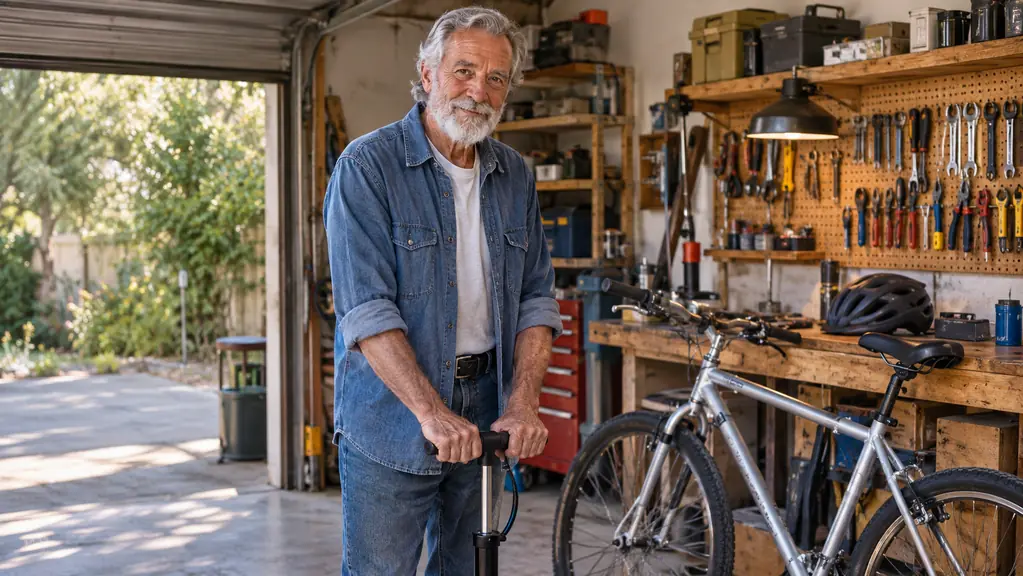
A mini pump is a fine thing to own. It is a poor thing to use every day. I figured that out slowly, over three years of crouching in my garage and squeezing a tire with my thumb, because the gauge on my old floor pump had quit and I kept telling myself I would get to it.
I finally did, in the first week of March about two years ago, along with a few other things I had put off. I bought the Topeak JoeBlow Sport III myself, nobody handed it to me, and it has stood in the same corner of the garage ever since. Roughly 8,000 miles later I still top up both tires before every ride. What follows is not a spec sheet read aloud. It is ten plain reasons a floor pump earns its floor space at home in a way a small pump never will, particularly if you are past sixty and your hands have opinions.
The pump that ended three years of guessing at tire pressure
160 psi on a 3 inch analog gauge mounted mid-barrel, a TwinHead DX5 that takes Presta and Schrader without swapping parts, and a padded handle that does not grind into your palm.
Amazon Check today's price on Amazon →You get the pressure you set, not the pressure you guess
My old pump's gauge died and I did not replace it. For three years I checked tires by squeezing them, which tells you very little at 40 psi and nothing at all at 60. The JoeBlow carries a 3 inch analog gauge mounted mid-barrel. I run 60 in the front and 65 in the back, and I can see where the needle sits before I finish the first stroke. That number is the entire reason to own a pump with a dial on it.
Sixty psi takes a handful of strokes, not a handful of minutes
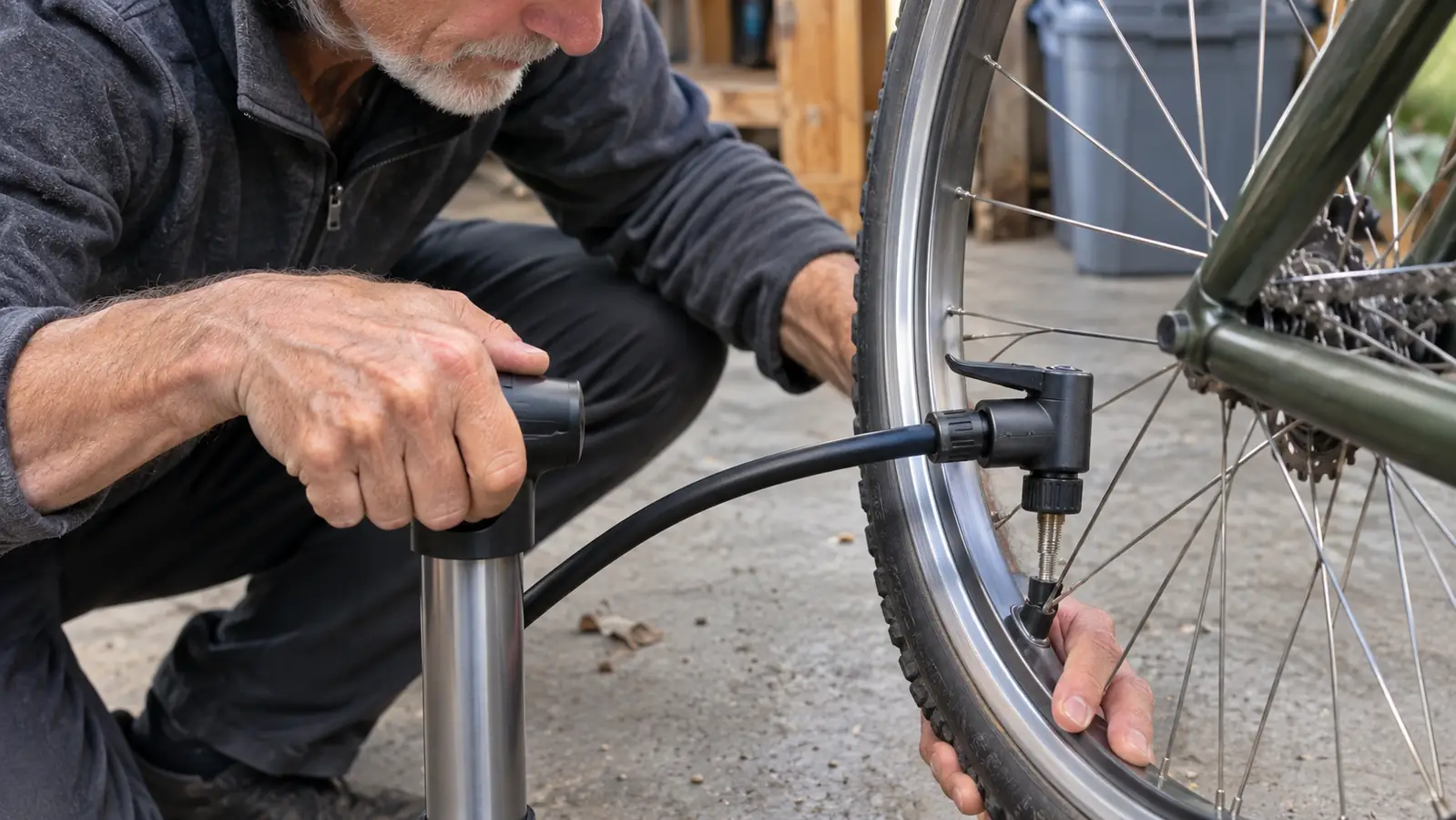
Small pumps move small air. That is the trade you accept for something that fits in a bag. This pump is rated at 318 cubic centimeters per second of air flow, and you feel it in the first ten strokes. I am adding five or ten psi to each tire, not filling from flat, and I am done before the garage door is fully up. Twice a week, fifty to seventy miles a ride, that saved time is the difference between checking the tires and deciding not to bother.
Your hands and your lower back are not part of the job
This is the part that snuck up on me after sixty. A small pump asks you to brace it against the ground or the frame and work your arms and shoulders while hunched over. My hands are already sore after a long day and my lower back is stiff in the morning. The JoeBlow has an oversized padded handle and a body tall enough that I stand upright and push down. No shoulder work, no crouching on concrete. My hands stay out of it.
One head fits Presta, Schrader and Dunlop without swapping parts
I run Presta valves on 32 mm tires with tubes. Ed's bike takes the same. But there are Schrader valves on the wheelbarrow and on my daughter's tires when she drives up from Tucson. The Topeak TwinHead DX5 is a hammer style head that fits all three, and it seats with a push rather than a threaded collar you have to fiddle with. Nothing to unscrew, nothing small to drop in the gravel. You put it on and it holds.
The hose reaches the valve wherever the bike is hanging
My bike hangs from a hook or leans against the bench, depending on the day and how much room I have left. An extra-long hose that rotates 360 degrees at the head means I do not have to wrestle the frame around to line up a valve. I walk the head to the wheel. The pump stays put. Small thing, but it is the difference between topping up in fifteen seconds and skipping it because it has become a nuisance.
The gauge sits where you can read it standing up
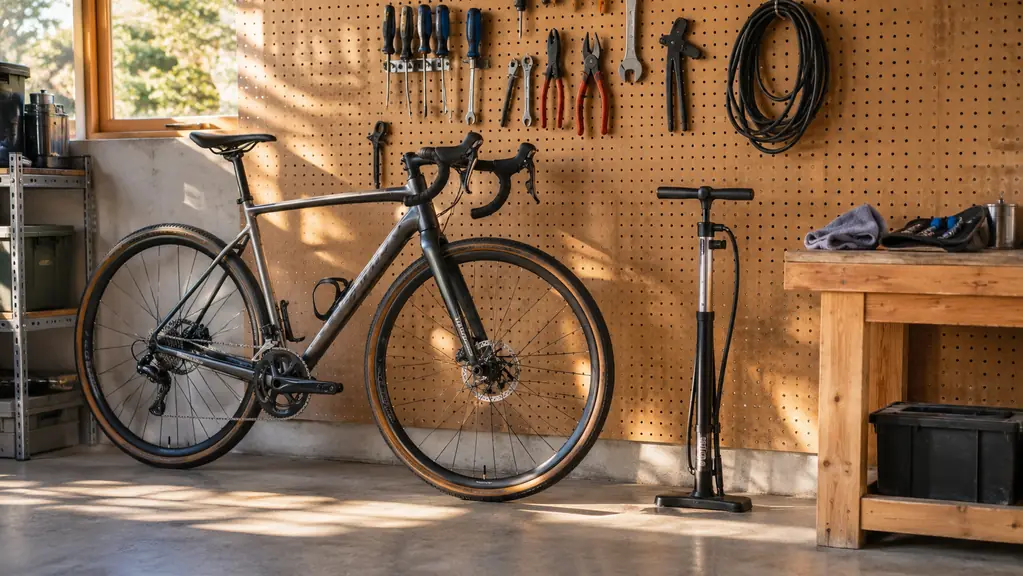
A gauge at the bottom of a pump means you bend to read it, and a gauge on the handle means you read it at a bad angle in poor light. Topeak mounted the 3 inch dial mid-barrel, so it sits around knee height and faces up. I read it without my glasses, which at 67 is not nothing. It goes to 160 psi, far more range than I will ever need at 60 and 65, but the needle sweeps wide enough that the numbers I care about are not crowded together.
It stands on its own base, so you push down instead of wrestling
The whole pump is 3.7 pounds and 27 inches tall, on a base of alloy steel. You put one foot on the base and push. That is the entire technique. I have never had it walk across the floor or tip mid-stroke. I will say the base is light enough that if you yank the hose sideways instead of lifting the head off straight, it will lean on you. Lift the head, do not yank it, and it stands fine.
You check pressure every ride because it costs ten seconds
This is the real reason, and it took me a while to see it. A pump you dread using is a pump you skip. When checking a tire is a chore, you stop checking and start guessing, and guessing at 60 psi is how you roll out on a cold morning on a tire that is 20 psi low. Because the JoeBlow is standing there ready, I top up before every single ride, twice a week, spring through fall. That habit is worth more than any one feature on the box.
The ball and bladder heads let it earn the shelf it takes up
The pump comes with ball and bladder heads in the box. That means the basketball in the shed and the air mattress in the hall closet get filled from the same tool that does my tires. I would not buy a pump for that alone, but it is one more reason the thing stays out and gets used instead of living in a drawer behind the winter gloves. It also carries a one year manufacturer warranty, which is more than the old one gave me.
It stays home, and that is exactly the point
A floor pump is a garage tool. At 3.7 pounds and 27 inches, nobody is strapping it to a frame. My seat bag carries a spare tube, a patch kit, two plastic tire levers and the M19, and that bag handles the road. The pump waits at the bench. Ed runs a Lezyne Steel Floor Drive in his own garage and it does the same job for him, so this is not a claim that only one pump works. It is a claim that the home job and the road job are two different jobs.
Two years of topping up before every ride, and the needle still lands where it landed the first week.
What I'd Skip
Skip the idea that one pump covers everything. Skip the upgrade to a digital gauge, too, at least for this job. I am reading 60 and 65 psi, not calibrating instruments, and a 3 inch analog dial at knee height is easier to read in a dim garage than a small screen. Skip the second floor pump for the shed when the ball and bladder heads already let this one travel that far.
What I would not skip is the fit. If you have sore hands, a stiff back or a left knee that complains on the climbs, do not buy a pump you have to hunch over to use. Look for a padded handle and a body you can stand behind. Then pick a pressure you like, mine is 60 front and 65 rear, write it on an index card and tape it to the bench so you stop re-deciding it every morning. And if sore hands or a sore back do not clear up, see your doctor. A better pump fixes a bad habit. It does not fix a medical problem.
Ten seconds before every ride beats a guess every single time
The Topeak JoeBlow Sport III stands 27 inches with a padded handle, reads to 160 psi on a 3 inch gauge, and has been in the same corner of my garage for two years.
Amazon Check today's price on Amazon →