

I spent three years guessing at tire pressure with my thumb. The gauge on my old garage pump quit somewhere along the way and I never got around to replacing it, so every ride started with a squeeze and a shrug. I run 60 psi in the front tire and 65 in the rear on 32 mm tires with tubes, and for three years I could not have told you whether I was actually getting there. I could tell you when I was not. A soft rear tire on chip seal at 5,400 feet feels like riding through wet sand.
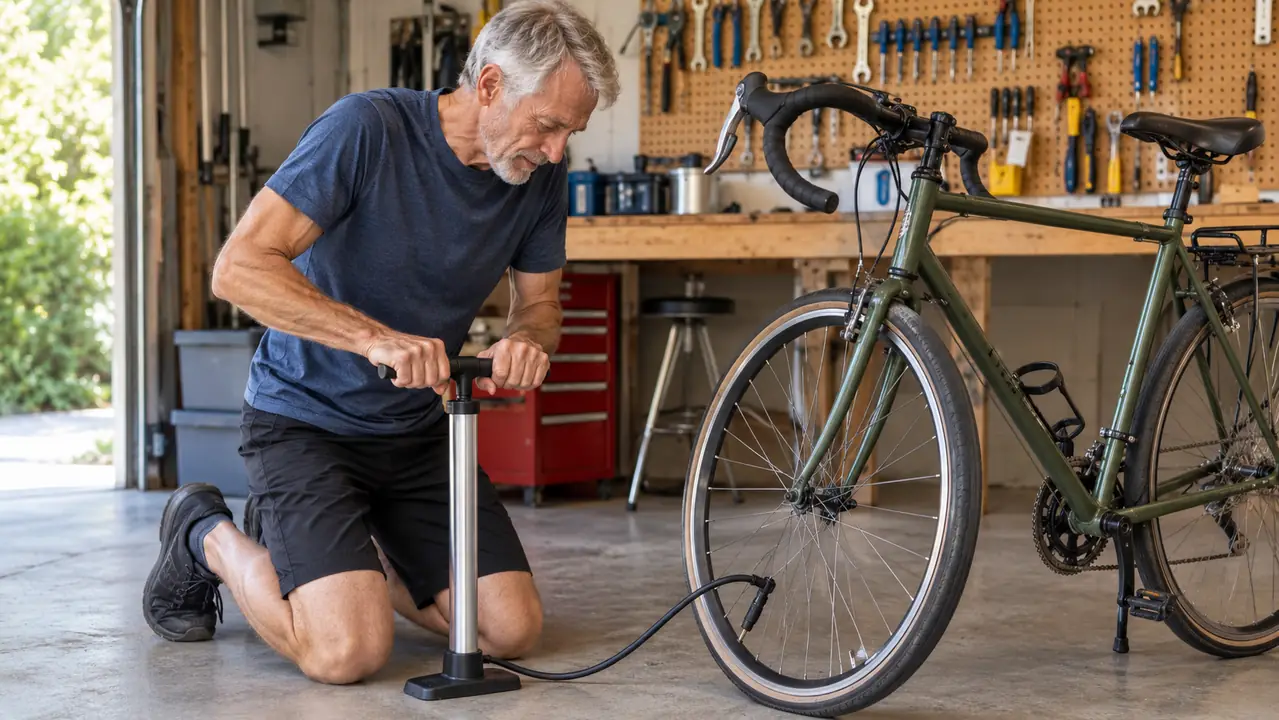
The Topeak JoeBlow Sport III came home with me in the first week of March about two years ago, along with a few other things I had been putting off. It has lived on the garage floor next to the bench ever since. Never on the bike, never in the car. It weighs 3.7 pounds and stands 27 inches tall, and it is not a thing you carry. It is a thing you walk past on your way out the door and use for thirty seconds before every ride. Two years and roughly 8,000 miles later, that is still its whole job.
The Quick Verdict
A dead simple garage pump with a dial you can read without glasses and a head that fits everything on my bench. The gauge goes coarse below 80 psi and the pump will tip if you yank the hose, but two years in, it has not skipped a beat.
Amazon Check Today's Price →The one thing I touch before every single ride
Sixty seconds at the bench beats twenty minutes on the shoulder of the highway. If your gauge died years ago and you have been squeezing tires ever since, this is the cheapest way back to knowing.
Amazon Check Today's Price on Amazon →How I've Used It
I top up before every ride. Not every other ride, not once a week. Every ride, because tires with tubes lose pressure sitting in a cold garage and because I would rather spend ninety seconds at the bench than twenty minutes fixing a flat on the shoulder of Highway 89. The routine never changes. Wheel around, hose on, watch the needle, flip the head off, next tire. The head has never failed to seal. The pump has never needed more than a handful of strokes to get from where the tires sit after a week back up to where I want them.
My long days are 50 to 70 miles, twice a week, spring through fall, and most of them start with real climbing out of Prescott. I am not chasing seconds. I am 67 years old with a lower back that stiffens and hands that complain by mile 50, and tire pressure is one of the few things on the bike I can control exactly. Getting it right means the rear tire does not wallow in the corners on the drop into Chino Valley. Getting it wrong means I feel every seam in the asphalt for the last twenty miles home.
Ed, who is 70 and retired from the mail, rides with me on many of those days. He keeps a Lezyne Steel Floor Drive in his own garage. We compare notes the way old men do, which is to say we mostly agree and then talk about something else. I have pumped a tire with his Lezyne twice, in his driveway, and it is a fine pump. I have never owned one. I want to be plain about that, because there are reviews online written by people who claim to have lived with five pumps at once, and I am not one of them.
The Gauge Is the Whole Reason to Own It
The reason this pump is on my bench instead of the old one is the dial. It is a 3 inch analog gauge mounted mid barrel, and it reads to 160 psi. The needle is big enough to see without my readers, which at my age is not a small thing. I do not need 160 psi. I need to know the difference between 55 and 65, and the dial shows me that clearly enough in one glance.
It is not a precision instrument at the low end. The marks between 40 and 80 sit close together, and if you are the sort of rider who wants to know whether you are at 62 or 64, this face will not tell you. I settled that by picking a setting and sticking to it. I know what 60 looks like on that dial and what 65 looks like, and I stop pushing when the needle sits there. For a steel touring bike on 32s, that is plenty. If you are chasing two psi on a race setup, you want a digital readout. This pump does not have one and does not pretend to.
What the gauge actually did was end the guessing. I had been running pressure too low for years, mostly in the rear, mostly out of caution about pinch flats. Once I could see the number, the rear tire stopped feeling vague on descents and I stopped getting the slow seep that comes from a tire that never quite seats right. That is not a dramatic improvement. It is one less thing to wonder about, and at my age the list of things to wonder about is long enough already.
The TwinHead, the Hose, and Cold Mornings
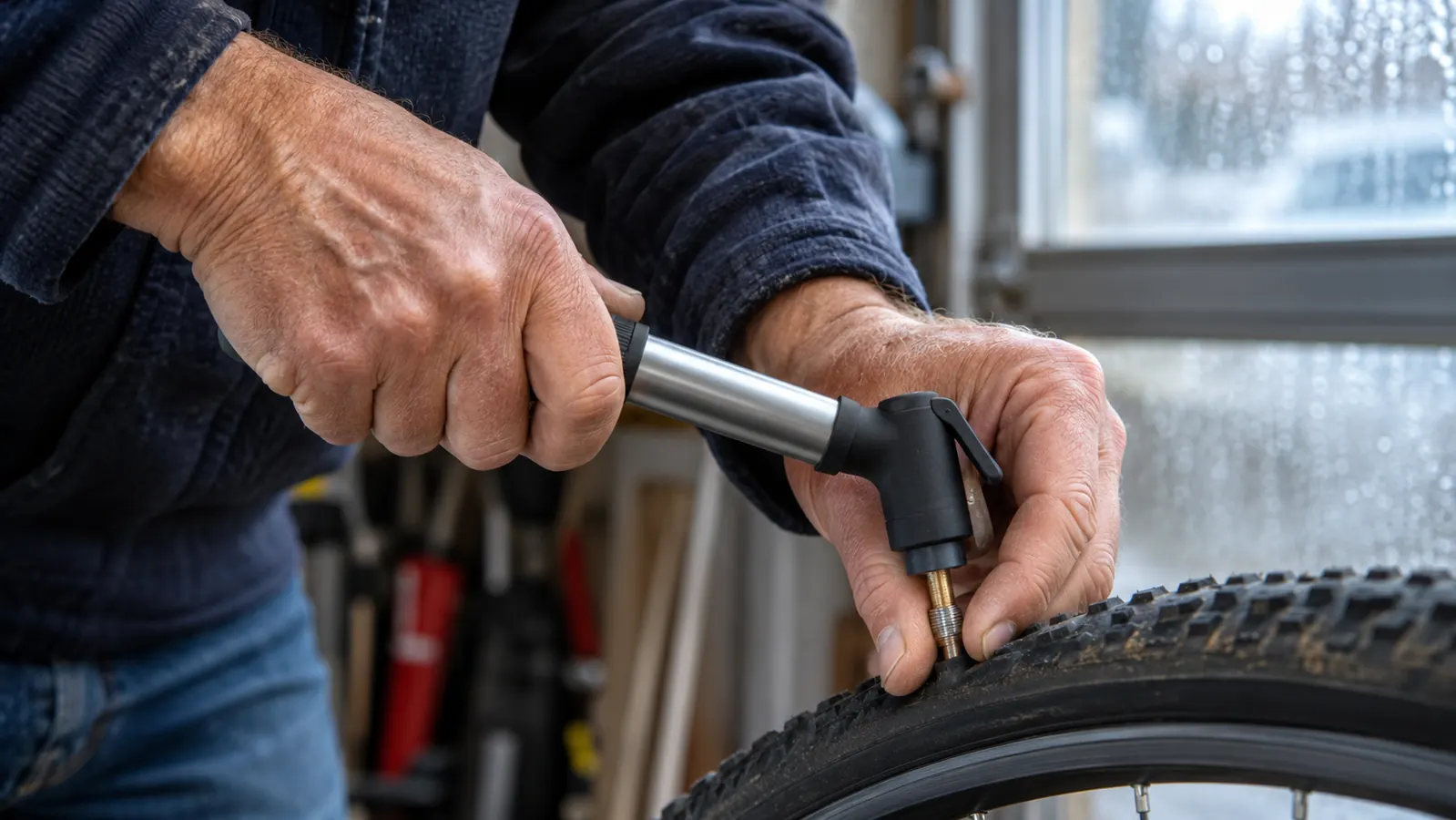
The head is a hammer style TwinHead DX5, and it fits Presta, Schrader and Dunlop. My bike runs Presta, so that is what I use day to day, but the Schrader side gets work on the wheelbarrow and on Beth's car tires when she drives up from Tucson. The head pushes on and a lever flips to lock it. I have had exactly one sealing problem in two years, and it was my own fault for not pushing the head on far enough before flipping the lever.
The hose is long and it swivels a full 360 degrees where it meets the barrel. That matters more than it sounds. The pump sits on the floor and the bike is usually in a stand at bench height, and a hose that turns freely means I am not fighting it while holding the head on with one hand. My old pump had a stiff hose that wanted to go one direction, and every top-up turned into a small wrestling match before I had even started the ride.
The handle is oversized and padded. I have a sore right hand from thirty odd years of holding a plane and a chisel, and the wide grip lets me push with my palm instead of squeezing with my fingers. In the cold months, when the garage sits at 40 degrees and my hands are stiff, that is the difference between a chore and a bad start to the morning. The handle has not loosened or cracked. The barrel is alloy steel, and after two years of sitting near a bench where tools get dropped, it still looks like a pump and not like a casualty.
Where It Gives Me Trouble
Two complaints, and neither one will make me replace it.
First, the base. The pump stands on its own fine, but it is not heavy, and if you yank the hose sideways instead of lifting the head off straight, the whole thing tips toward you. I did it twice in the first month and learned to rest my free hand on the barrel. It has not happened since. If you are the sort who grabs the hose and pulls, you will knock it over, and it will be on a morning when you are already running late.
Second, the gauge, from the other direction. It is generous at the top of the scale and tight at the bottom. A rider running high pressure on narrow tires will find the dial easy. A rider running low pressure on wide tires, which is what a lot of us older folks do now, will find the useful part of the scale squeezed into a small arc. You learn it. But you learn it by overshooting a couple of times first.
There is also the matter of what it does not come with. It ships with ball and bladder heads, which I have used on a basketball and on the air mattress in the guest room. It does not come with a case, and the hose does not retract. It sits on the floor and the hose loops where it loops. My garage is not a showroom, so this has never bothered me. If you keep your pump in a closet, you will want a hook on the wall.
What I Compared It To
I bought this pump in the same week as the rest of my kit and I bought it without testing anything else first. What I did do was read the listings and ask Ed. His Lezyne Steel Floor Drive is the only other floor pump I have real hands-on time with, maybe a dozen strokes total across two visits. It has a steel barrel and a similar footprint, and it does the same job.
The difference I could actually feel was the head. His Lezyne uses a threaded chuck on the Presta side, so you screw it on. That seals well. It also takes longer, and on a cold morning with stiff fingers it is one more step I would rather not do. The Topeak is push and flip. Neither approach is wrong. I picked the one that matches how I use a pump, which is fast, in a cold garage, before coffee.
I also looked hard at the small pumps. A mini pump lives in a seat bag and I carry one, along with a spare tube, a patch kit and two plastic tire levers. But a mini pump is an emergency tool. It gets you home. It does not get you to 65 psi in ninety seconds and it does not have a gauge you can read at arm's length. If you ride 50 to 70 miles twice a week, you want the big one in the garage and the small one in the bag. That is not a controversial position.
What I Liked
- 3 inch analog dial is readable at arm's length without glasses
- TwinHead DX5 fits Presta, Schrader and Dunlop with no parts to swap
- Long 360 degree hose does not fight you at bench height
- Oversized padded handle is kind to sore, stiff hands
- Alloy steel barrel has held up through two years of garage use
- Ball and bladder heads included for the odd household job
Where It Falls Short
- Gauge scale is cramped between 40 and 80 psi where many older riders live
- Pump will tip if you yank the hose without steadying the barrel
- No digital readout for riders who want exact numbers
- At 3.7 pounds and 27 inches tall it stays where you put it
- Hose does not retract and there is no case
I do not need to know my pressure to a tenth of a pound. I need to know it is not 50 when I think it is 65, and this dial settles that in one glance.
Who This Is For
This pump suits the rider who does their own top-ups at home, runs tubes, and wants one honest number before heading out. It suits anyone whose last pump had a gauge that quit and who has been squeezing tires ever since. It suits older hands, because the padded handle lets you push with the heel of your palm rather than grip, and it suits anyone who keeps the pump in one spot on the garage floor and never needs to move it.
It also suits the rider who is not interested in learning an app or charging a battery to put air in a tire. There is nothing to pair, nothing to update, and nothing to run down. The Topeak JoeBlow Sport III does one job with a lever and a needle, and the one year manufacturer warranty is the least interesting thing about it, which is how it should be.
Who Should Skip It
Skip it if you run tubeless at low pressure and want to know exactly where you are. The dial is honest but coarse down there, and you will spend more time squinting than pumping. Skip it if you want a digital number, because this pump will never give you one.
Skip it if floor space is tight or the pump has to travel. It is 27 inches tall and it is not going in a trunk alongside a bike. And skip it if a pump that can tip over would drive you up the wall, because it can, and no amount of getting used to it changes that. For everyone else, the Topeak is the last floor pump I expect to buy for a good long while.
Two years on my garage floor and it still reads true
If your ride starts with a thumb squeeze and a shrug, this ends it. One dial, one lever, thirty seconds, and you roll out knowing exactly what is in your tires.
Amazon Check Today's Price on Amazon →