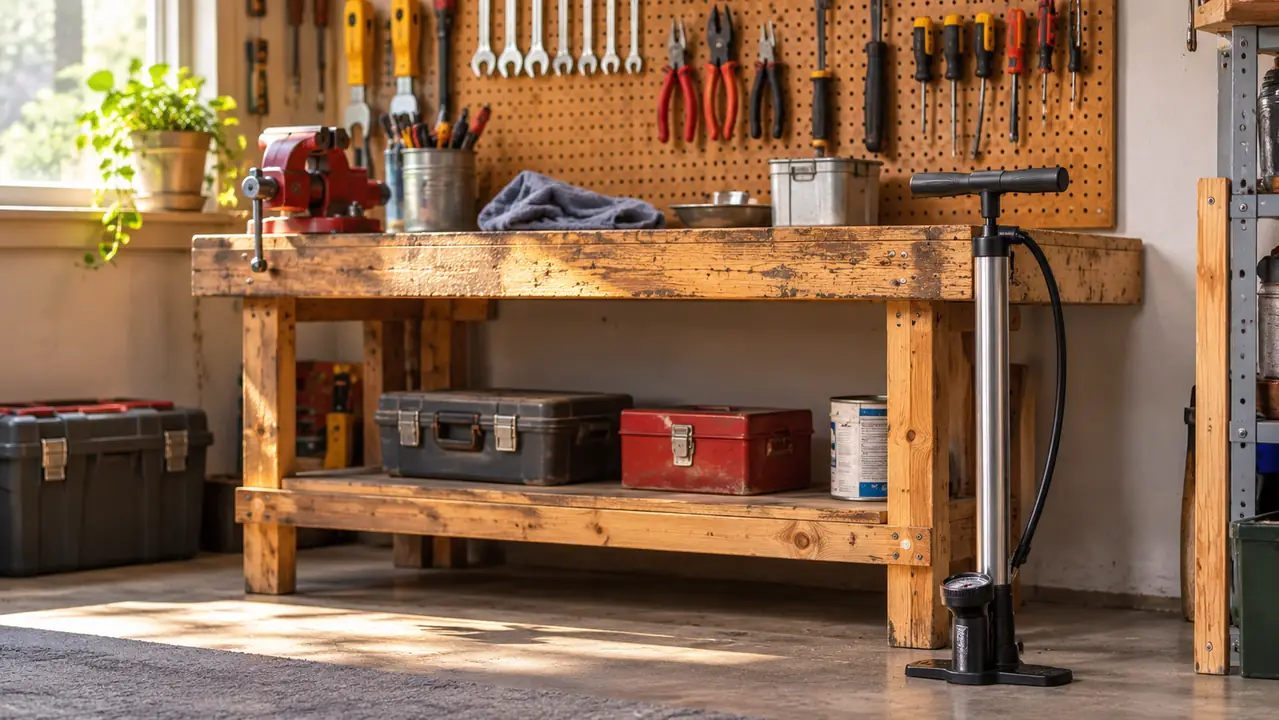
Short answer first, because that is what I want when I read one of these. I have had the Topeak JoeBlow Sport III standing beside my garage bench for about two years. If it walked off tomorrow I would order the same pump again. My riding partner Ed, who is 70 and a retired mail carrier, has a Lezyne Steel Floor Drive bolted to the wall of his shop, and it is a good pump. It is also a different pump for a different habit, and that is the whole comparison in one line.
I am 67. I ride 50 to 70 miles at a stretch twice a week out of Prescott, and I do my own wrenching at a bench in the garage. A floor pump is not a piece of equipment I get romantic about. What I want from it is narrow: the head goes onto a Presta valve without a fight, the gauge tells me something close to true down at 60 psi, the thing stands still while I lean on it, and it still works in five years. Everything past that is decoration, and you should read the rest of this with that in mind.
How I Ended Up With Two Pumps to Compare
Before this pump I had an old garage floor pump with a broken gauge. For three years I set tire pressure by squeezing the tire with my thumb, which is a fine method if you enjoy guessing. My notes from that stretch are full of entries like felt soft, added air, with no number attached to any of them. I did buy a cheap pencil gauge to settle it, and that was worse. The thing read 55 one morning and 70 the next on the same tire, and I never did work out which end of it was lying. So I went back to the thumb. That is not a way to run a bike you plan to ride 4,000 miles a year on.
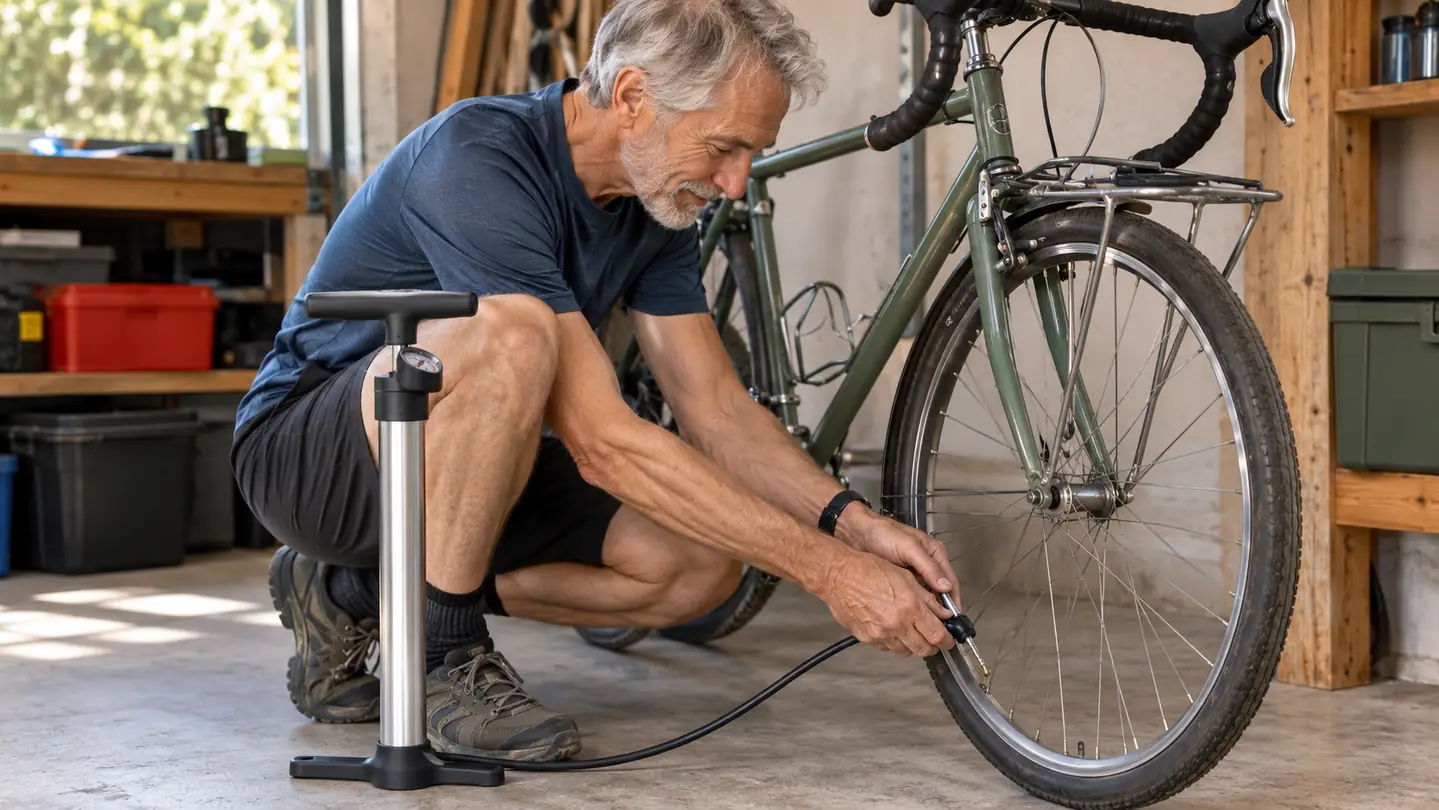
I bought the Topeak in the first week of March, about two years ago, in the same week I replaced the rest of my kit after one bad 80 mile day the fall before. That day I flatted around mile 52 on Williamson Valley Road with no shade anywhere, got the tube changed, and then spent ten minutes working the tire with my hands trying to decide if it was hard enough. It was not. I rode the last 28 miles soft in the rear and paid for it in my lower back the next morning. Since then the pump and I have gone through roughly 8,000 miles together, which for a pump means something closer to two hundred sessions in the garage than it does to mileage. It does not go on the bike. It lives by the bench, and before every ride I top up 60 in the front and 65 in the rear. That is my setting for my roads and my weight, not a rule for anybody else.
Ed's Lezyne I know from his garage, not from my own. I have used it maybe a dozen times when we met at his place before a ride, and I have stood there while he used it a good many more. I have never owned one, and I am not going to write as though I rode it for two years. What follows is what I can see and feel on his, plus what the listings say, and I will mark the difference where it matters.
The Two Pumps Side by Side
Here is the honest scorecard. Read the right column as carefully as the left, because there are rows where Ed's pump is simply better and I am not going to pretend otherwise to make my own purchase look smart.
| Topeak JoeBlow Sport III | Lezyne Steel Floor Drive | |
|---|---|---|
| Gauge | 3 inch analog dial mounted mid-barrel, reads to 160 psi, legible from standing height without readers | Gauge sits lower on the barrel and I bend to read it every time on Ed's |
| Valve head | TwinHead DX5 hammer head pushes onto Presta, Schrader or Dunlop and flips to lock, no threading | Thread-on chuck, a couple of extra turns to seat and release on a Presta valve |
| Hose | 360 degree hose, long enough to walk around the bike without dragging the base | Reach is a touch longer and it hangs on the hook without kinking |
| Handle | Oversized padded handle, easier on sore hands when you are pushing hard | Slimmer handle, less material to hold onto |
| Stability | 3.7 pounds total, and the base can tip if you yank the hose sideways | Heavier barrel sits flatter and does not walk across the floor under a hard stroke |
| Pressure ceiling | 160 psi, or 11 bar | Rated above anything I will ever put in a 32 mm tire |
| Moving it | 27 inches tall, 10 by 4.6 at the base, one hand to carry out to the truck | Heavy enough that Ed bolted his to the wall and left it there |
| Extra heads | Ball and bladder heads included in the box | Not part of what Ed has mounted on his wall |
| Warranty | 1 year manufacturer | I have never had to find out what Lezyne covers |
| Best for | Topping up 60 front and 65 rear in your own garage twice a week | One heavy pump with a permanent home that never shifts under your hand |
Nothing in that table is a knock on either pump. It is a list of where each one puts its money. The Topeak spends it on the parts you touch every single time you inflate a tire. The Lezyne spends it on mass and on staying put.
Where Topeak JoeBlow Sport III Wins
Start with the gauge, because it is the reason I bought this pump and the reason I would buy it again. It is a 3 inch analog dial mounted mid-barrel, it reads to 160 psi, and I can see the needle from a standing position with my glasses on the workbench where I left them. That sounds like a small thing until you have spent two years bending over to squint at a gauge at six in the morning with a stiff lower back. On Ed's pump the gauge sits lower on the barrel, and I bend for it every time. If you are 50 or older and your back already files complaints, this is not a detail. It is the decision.
The head is the second thing. Topeak calls it the TwinHead DX5. It is a hammer-style head: you push it onto the valve and flip the lever, and it fits Presta, Schrader and Dunlop without changing a part or unscrewing anything. My touring bike runs 32 mm tires with tubes and Presta valves, and the head goes on square in one motion, first try, most mornings. When my hands are stiff on a cold start, that matters more than any number on a spec sheet. Ed's thread-on chuck is more secure, I will give it that, but it costs me a couple of extra turns getting on and off, and I have watched him do those turns with cold fingers more than once.
Then the small things that add up over two hundred sessions. The handle is oversized and padded, which is noticeably easier on sore hands than a slim one when you are pushing past 60 psi. I counted strokes one morning out of curiosity, and the rear went from 40 to 65 in about fifteen of them, which is well under a minute even at my pace. The pump weighs 3.7 pounds and stands 27 inches tall, so I carry it to the truck with one hand and stand it against the wall without a bracket. I have dropped it on the concrete twice, once off the tailgate of the truck, and the gauge still sits at zero when it is at rest and the barrel has not gone out of true. It came with ball and bladder heads, and I have used them on a basketball and on an air mattress, which is more than I expected to use them. It is manual operation, no battery to think about, and the listed air flow of 318 cubic centimeters per second means a 32 mm tire goes from soft to 65 psi in a short run of strokes rather than a workout.
Where Lezyne Steel Floor Drive Wins
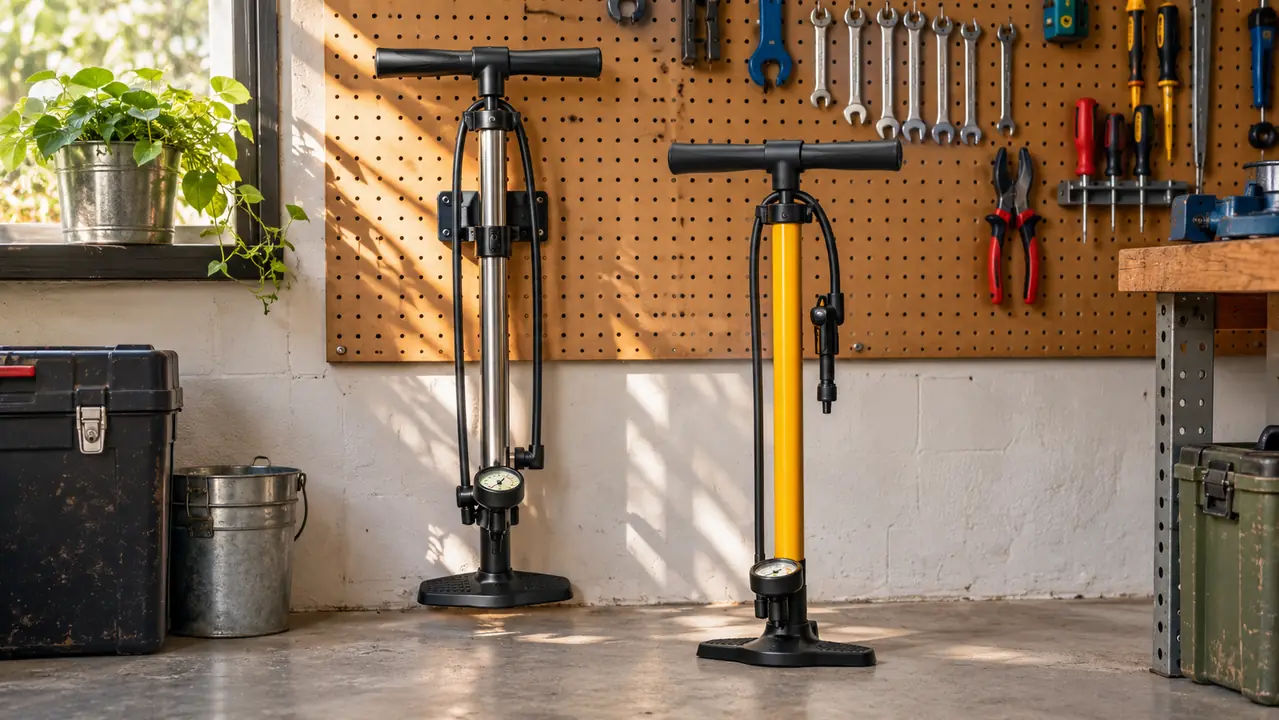
The Lezyne wins on staying put, and it is not close. Ed's pump is a heavier piece of steel, it sits flatter on the floor, and when you lean into a high pressure stroke it does not walk. My Topeak has a light base for its height, and if I yank the hose sideways instead of lifting it, the whole pump will tip. I have done it. Twice, both times in a hurry, and both times I said something unkind about a pump that had done nothing wrong except be light enough to carry.
The hose is the other place his pump is better. The reach is a touch longer, and it hangs on the hook without kinking the way mine does if I coil it wrong. With the bike leaning against the truck on a windy morning, that extra reach means I can stand beside the bars instead of crouching down at the fork. And the thread-on chuck, for all that it is slower, will hold at pressures I never use and will not let go in the middle of a stroke. If you ride narrow tires and pump them hard, that security is worth the extra turns.
What I would not give him is the gauge placement, and I would not trade heads. But if your pump lives on a wall, gets used at high pressure, and you hate a tool that shifts under your hand, his is the better instrument for that job.
The Topeak spends its money on the parts you touch every time you inflate a tire. The Lezyne spends it on mass and on staying put.
The pump that has stood by my bench through two years of Prescott mornings
A 3 inch gauge I can read standing up, a TwinHead DX5 that goes onto a Presta valve in one push, and 160 psi on tap. If your pump lives beside the bike in the garage, this is the one I would buy again.
Amazon Check Today's Price on Amazon →What Neither Pump Fixes
Worth saying plainly, because a floor pump gets sold like it solves more than it does. Neither of these pumps will tell you the right pressure for your weight, your tires and the road you are riding that day. Neither will fix a slow leak, a tired valve core or a rim strip that has crept out of place. My 60 in the front and 65 in the rear came out of two years of notes and a lot of trial, not out of a gauge. The pump's only job is to put air in accurately and repeatably so that your own numbers stay meaningful.
I chased a slow leak for three weeks last spring, at first certain it was the pump, then certain it was the tube, then certain I was simply misreading the dial. It was a valve core a quarter turn loose. Neither pump would have told me that. I found it by holding the wheel under the faucet in the laundry sink and watching for a bead of air, a trick old enough that my shop students knew it before I taught it to them.
That repeatability is the real argument for owning one decent floor pump instead of four cheap ones. Use the same gauge every time and you learn what 60 psi feels like through the frame, and then you notice when something is off before it becomes a flat at mile 40 with no shade. Neither the Topeak nor the Lezyne is a laboratory instrument, and I would not treat either reading as gospel. What matters is that it reads the same way twice, week after week, for years. Mine has.
Who Should Buy Which
Buy the Topeak if your pump lives indoors and gets used the way mine does: a top-up before every ride, 60 in the front and 65 in the rear, twice a week, plus the occasional car tire, basketball or air mattress. Buy it if you are older and your hands and back complain, because the padded handle, the readable gauge up at chest height and the push-on head each shave a little effort off a job you do two hundred times a year. Buy it if you want one pump you can grab with one hand and carry out to the truck without unbolting anything from a wall. And if you have ever lugged a pump up a set of garage stairs, you already know why 3.7 pounds is the number that matters.
Buy the Lezyne if your pump has a permanent home and does not travel, if you run narrow tires at high pressure, or if a pump that shifts under your hand drives you up the wall. Ed is 70 and has had his bolted to the same spot for years, and for the way he works it is the right pump. Neither of us is wrong. We just inflate tires in different rooms, and you probably know which room you are standing in.
Two years of my notes, one honest verdict
It is still the pump I reach for before every ride. Check today's price and see whether it fits the way you actually pump tires.
Amazon Check Today's Price on Amazon →