
I came home from an eighty mile ride in the fall about two and a half years ago and sat in the truck for a while before I could drive. My hands were fine. My back was stiff, which is normal. The real problem was that I had spent the last thirty miles sliding around on the stock saddle that came with my bike, and nothing I did made it better. I am 67 now, about 5 foot 10 and 160 pounds, and I ride 50 to 70 miles twice a week out of Prescott. I do not race. I just want to finish the day and still want to ride on Thursday.
That winter I replaced five things at once. The one that changed the most was the saddle. I bought the Brooks England Cambium C17 Carved in the first week of March, along with a pump, a multitool, bib shorts and a GPS computer, and I have ridden it for about two years now, roughly 8,000 miles. The short version is that a good saddle does not make you faster. It makes the last twenty miles of a long day feel like the first twenty, and that is worth more to me than any weight saving on the market.
If you change one thing before your next long season, change this
I replaced a pump, a multitool, my shorts and my navigation before I replaced the saddle, and the saddle was the only one of the five that I noticed on the very first ride. Here is the exact one on my bike.
Amazon Check Today's Price on Amazon →You stop counting the miles left until you can stand up
The saddle that came on my bike was not a bad saddle. It was built for a rider who goes twenty minutes. On my first long ride with the Brooks England Cambium C17 Carved I kept waiting for the point where I normally start shifting around, and it did not come. There is no break-in period on this top, so the first ride is the ride. Nothing to suffer through for six weeks hoping it gets better.
The center cutout takes the pressure off the parts that go numb
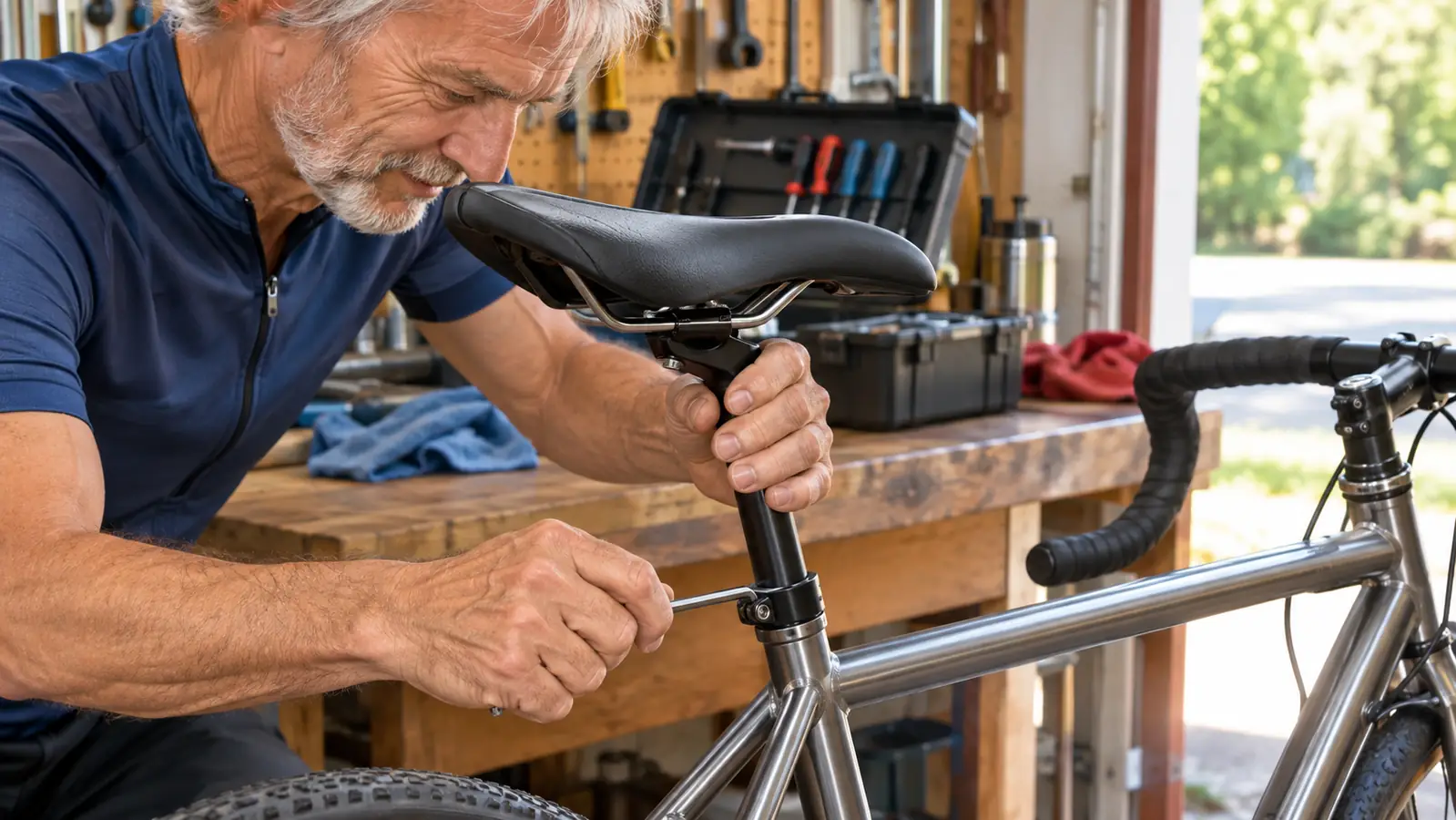
The Carved version has a channel cut down the middle of the top, and on a long day that is the difference between an annoyance and a real problem. On the old saddle I would lose feeling somewhere past mile fifty and spend the rest of the ride standing on the pedals more than I wanted to. With the cutout I do not. If numbness does not clear up after a ride, see your doctor. Mine cleared up.
There is no break-in period and nothing to maintain
The top is vulcanized natural rubber under an organic cotton canvas, with a thin structural textile layer for resilience. There is no leather to feed, no tension bolt to turn, and nothing to proof. In two years I have done exactly one thing to this saddle: wiped the dust off with a wet rag a couple of times a season. Ed, the man I ride with, has a leather saddle and gives it an evening every spring. He enjoys that. I do not.
Rain does not end the ride early or cost you a saddle
The nylon cover is waterproof, and in Prescott that matters more than people expect. We get afternoon storms in July that come out of nowhere and dump hard for twenty minutes. I have ridden home soaked more than once and the saddle has been fine. No cover to remember, no bag to pull over it, no leather drying slowly in the garage for two days. A saddle that stays wet is a miserable thing to sit on the next morning.
The top gives under you instead of fighting you
Vulcanized rubber flexes. Not a lot, but enough that chip seal stops coming straight up through the bike. The stock saddle was a hard shell with a thin pad on it, and every seam in the road went right through. I run 32 mm tires at about 60 psi front and 65 rear as my own setting, and between the tires and the rubber top, the road surface stopped being the main thing I think about on a long day.

Six and a half inches of width holds your position all day
It measures 11.14 inches long, 6.5 inches wide and 2.05 inches high. That width is the part that matters for me. I am not a small man and I do not ride in a racer's crouch, so I want a platform under me, not a razor blade. Once I got the height and the tilt set in that first week, my position stopped drifting forward over the course of a long ride.
A firm top is kinder on a long day than a soft one
People assume soft equals comfortable on a bicycle and for me it is backwards. Foam compresses and you end up sitting on the shell underneath it. This top is firm, and firm holds you up instead of letting you sink into it. The first ten minutes of the first ride felt strange, I will not pretend otherwise. By the end of that week I would not have traded it back.
Two years and 8,000 miles later it still looks like a saddle
The canvas has dulled a little, which I like. The rails are straight. The structural layer under the top is doing whatever it does and I have not had to think about it. This bike lives in a garage that hits 100 degrees in June and I ride it in the rain and the dust. Nothing has cracked, split or started to peel. For a part I have never once maintained, that is a fair record.
450 grams is a trade I made with my eyes open
It weighs 15.68 ounces, about 450 grams, and that is heavier than a race saddle. I am not going to pretend otherwise. On a 50 mile day with real climbing out of Prescott, that weight is not what is holding me back. My own winter legs are what is holding me back. If you are chasing grams up a timed hill, this is the wrong part and you already know it.
A 100 kg rating and a two year warranty behind it
It is rated to 100 kg and carries a two year manufacturer warranty. I weigh about 160 pounds, so the rating is not something I personally test, but I like that a number is printed and a date is promised. Two years and roughly 8,000 miles in, mine is still doing its job, so I have never had to find out how the warranty process works. I would rather keep it that way.
What I'd Skip
I would skip leather if you are the sort of man who will not spend an evening on maintenance, because a leather saddle asks for it and resents being ignored. I would skip padded saddle covers, which are a way of hiding a bad fit rather than fixing it. And I would skip buying anything at all until you have spent a week moving the saddle you already own up and down and tilting the nose a degree at a time. A good saddle set wrong still hurts. That first week of fiddling with the Brooks England Cambium C17 Carved was not optional, and I would say the same about any saddle on the shelf.
Two years, roughly 8,000 miles, and the only thing I have done to the Brooks England Cambium C17 Carved is wipe the dust off it with a wet rag.
The one part I would buy again tomorrow without thinking about it
Five parts went on that bike in the same week. This is the one I would replace first if it disappeared tonight, and the one I have thought about the least in two years of riding.
Amazon Check Today's Price on Amazon →