
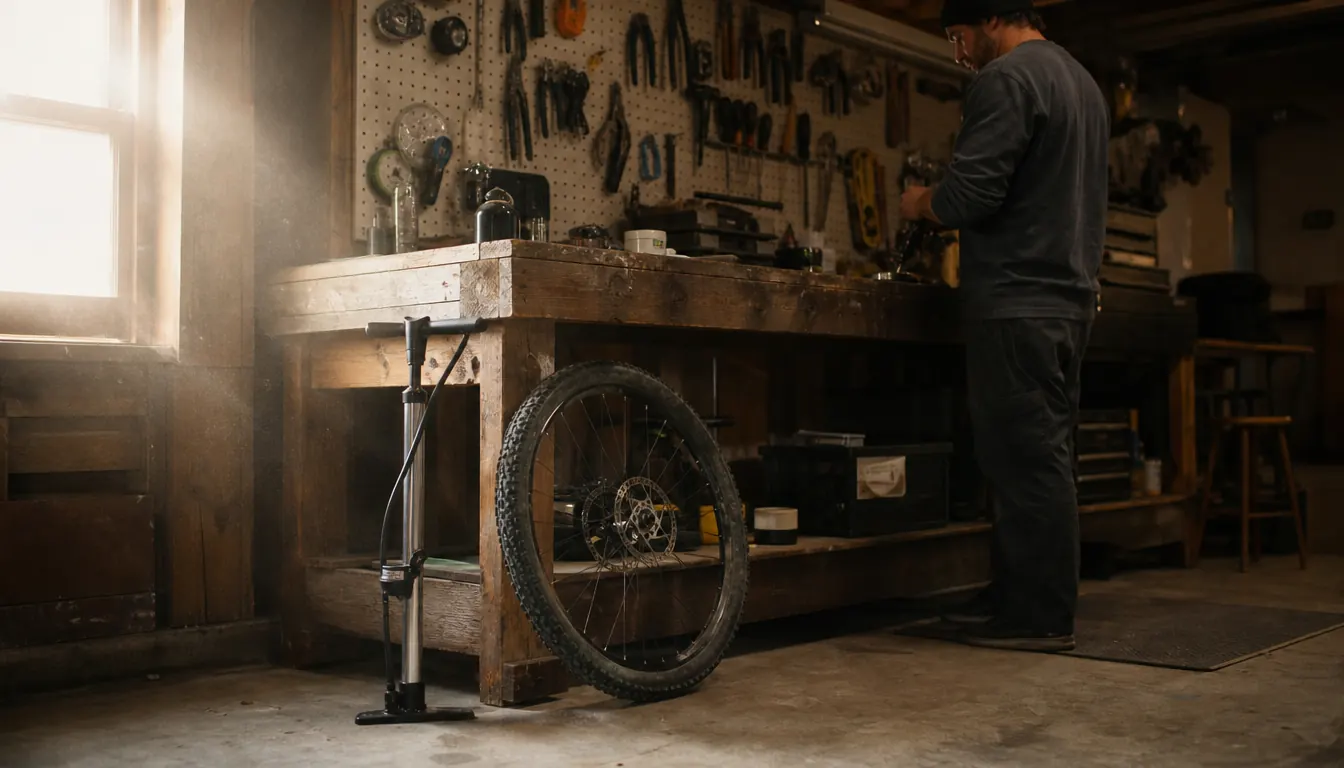
Nobody warns you that a floor pump is the piece of gear you will touch more than any other. Not the saddle, not the computer, not the shorts. Every ride starts with it, in the garage, before the light is any good. Two years and roughly 8,000 miles into owning the Topeak JoeBlow Sport III, I think of it the way I think of the bench vise I kept in my shop for 31 years: heavy, boring, and the reason the rest of the work goes right.
What nobody tells you is that I bought it for a dull reason. The gauge on my old pump had quit and I had been setting pressure by squeezing the tire with my thumb. That works until it does not. On a cool morning a 32 mm tire at 45 psi feels about like one at 60 under a thumb, and the difference shows up at mile forty on chip seal, with a pinch flat and the sun already high.
Before that there was the bad day: an 80 mile ride the fall before I replaced my kit, with a flat I fought at the roadside, a wrong turn on the way home, and a lower back that complained for two days after. When spring came I bought five things in one week, all at my own expense. The pump was the least interesting of the five. It is also the one I would replace first if it broke.
The Quick Verdict
A steel floor pump with a gauge I can read without my glasses and a head that clamps onto Presta and stays there. The 160 psi dial spends most of its face on pressures nobody I ride with uses, and the base will tip if you yank the hose. Not the last pump you will ever buy, but the one I would buy again.
Amazon Check Today's Price →The pump that ended my thumb-squeezing days
A 3 inch analog gauge, a TwinHead DX5 that fits Presta and Schrader, and a padded handle that does not chew up your palm at 65 psi. It lives in the garage and it earns its spot there.
Amazon Check Today's Price on Amazon →What a Floor Pump Actually Has to Do
A pump has one job and it is not 160 psi. Nobody I ride with runs anything close to that. I run 60 in the front and 65 in the rear on 32 mm tires with tubes, and I treat those as my own setting, not a rule I would hand to anyone else. The real job is to hit the same number twice, in a cold garage, with hands that are already stiff, in under a minute. Everything else on the box is decoration.
By that measure the Topeak is well built. Alloy steel barrel, 3.7 pounds, 27 inches tall, a footprint of about 10 inches by 4.6 inches. It stands on its own base and does not wander while you pump. The handle is oversized and padded, which matters more at 67 than it did at 40, because the last ten pounds of a top-up are exactly where my hands used to give out on the old pump.
The 3 inch gauge mounts mid-barrel, so you read it while standing over the pump instead of bending down to something near the floor. That placement is worth more to my lower back than any other feature on this pump. It reads to 160 psi, it is analog, and there is no digital readout anywhere on it. I will come back to that.
The listing puts air flow at 318 cubic centimeters per second. I cannot measure that and I will not pretend to. What I can tell you is that going from 40 to 65 psi on a 32 mm tire takes me somewhere around ten strokes, maybe twelve on a morning when my back is stiff, and I am not winded at the end of it. On the old pump it felt closer to twenty and I noticed every one of them.
How I've Used It for Two Years
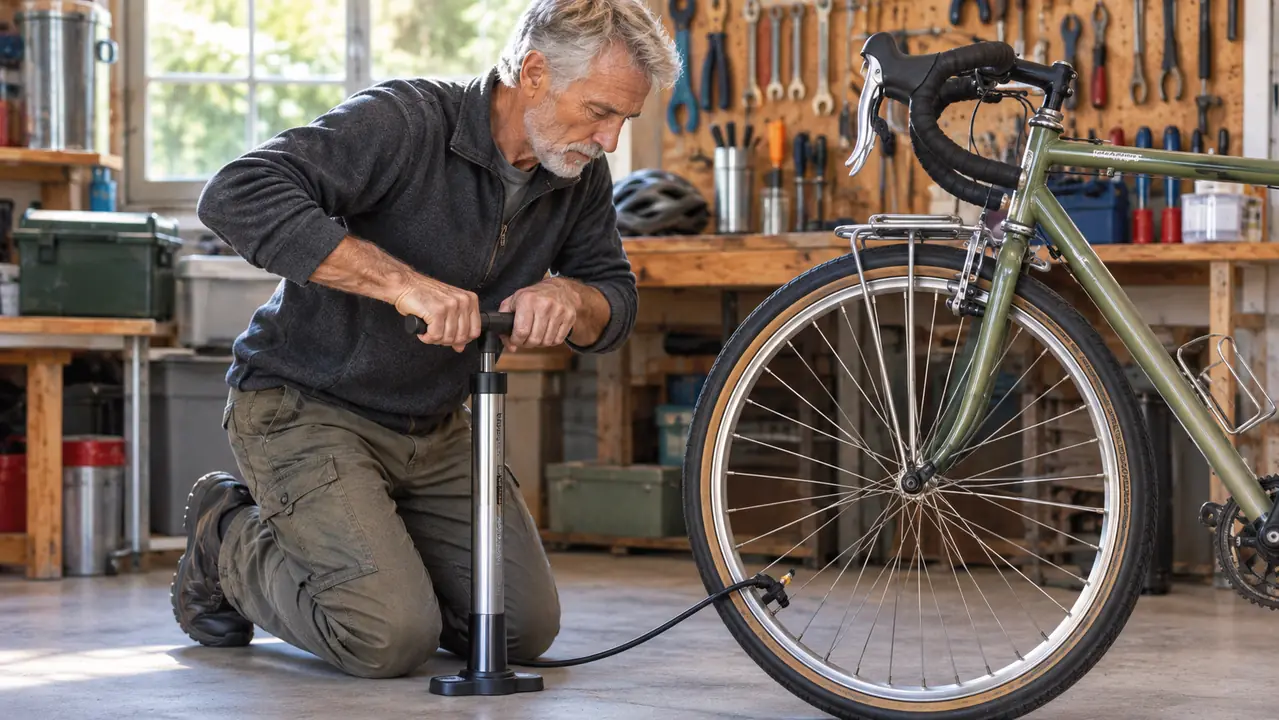
The pump has never left the garage. That is the whole use case: top up before every ride, roughly twice a week from spring through fall and shorter midday loops in winter, about 4,000 miles a year. Front tire, rear tire, coil the hose, go. Twice a season I pull the wheels and do a fuller check at the bench.
In that time the barrel has not scratched through, the hose has not cracked at either fitting, and the head still seals on a Presta valve without me holding it in place. The gauge returns to zero every single time, which sounds like nothing until you have owned a pump that does not. The padding on the handle has compressed a little where my palms sit. That is the only wear I can point to.
I want to be honest about what two years of garage use proves. It proves the seals hold, the head is not made of cheese, and the gauge still moves. It does not prove anything about the twenty-year pump somebody's father bought in 1979 and still uses. This is a 3.7 pound steel pump with a one year manufacturer warranty, and I would not expect any factory to stand behind a product longer than that on paper, whether or not it lasts longer in practice.
The other thing two years teaches you is how often you actually use the thing. Four hundred times, give or take. Four hundred small chances for a head to fail or a gauge to stick, and it has done neither. That is a better test than anything I could do in an afternoon.
Setup and the First Week
There is nothing to assemble beyond pulling it out of the box. The hose is already on the barrel and the head is already on the hose, with the ball and bladder heads bagged alongside. I stood it against the wall, checked the tires, and got on with it. The first week was spent learning the head: how hard to push, how square it needs to sit, and how it feels when it has actually seated versus when it has only almost seated.
The other thing I did in that first week was compare the new gauge against my thumb, out of curiosity. Two tires I had been calling good were six and eight psi low. That is the entire case for a working gauge in one sentence, and it is worth more than any feature list on the packaging. I have not gone back to guessing.
Where the Gauge Falls Short
Here is the honest complaint, and it is the one I would want to read before buying. The gauge reads to 160 psi and I live between 55 and 70. That is a narrow slice of a wide dial. Between 58 and 62 psi the needle moves a hairline. When I want 65 in the rear, I am reading a small angle of needle travel and estimating the rest with my eyes at six in the morning.
On the old pump with the dead gauge I had no number at all, so this is still a large step up, and I want to keep the complaint in proportion. A rider running 90 or 110 psi on narrower tires gets that same dial spread across a far more useful part of its face, and this criticism mostly evaporates for them. It bites at low pressure, which is exactly where a lot of riders my age on 32s and 35s live.
There is no digital gauge here. Nothing beeps, nothing stores a target pressure, nothing reads out to a decimal. If that is what you want, this is not that pump, and I would rather say so now than have you find out in your own garage with the light still bad.
There is a workaround and I use it. I keep a small notebook on the bench with two numbers written on the cover, 60 and 65, so I am not doing arithmetic in my head before coffee. I pump until the needle sits just past the mark, tap the face with a knuckle to settle it, and read again. A tap is worth a psi or two on any analog gauge and it costs nothing but a second.
The Head, the Hose, and a Base That Will Tip
The head is a TwinHead DX5, the hammer style, and the listing says it fits Presta, Schrader and Dunlop. My bike runs Presta, so that is the only one I can speak to from daily use. It wants a square, firm push onto the valve, more than the old screw-on head did, and if you set it on crooked it will hiss at you. Set it square and it holds without a hand on it while you pump.
The hose is extra long and swivels 360 degrees at the head, so I can stand on either side of the bike and reach both wheels without walking the bike around the garage. That sounds like a small convenience. Do it four hundred times and it stops being small.
The base is the weak point in daily handling. The pump is 3.7 pounds, light for a steel floor pump, and the base is wide but not heavy. When I yank the hose instead of lifting it clear, the whole pump leans toward me. It has never actually gone over, because I stopped yanking, but a heavier base plate would have saved me the lesson. If you are rough on tools, this is where it will show.
It ships with ball and bladder heads as well. I have never used them. There is no inflatable in my garage and no ball worth pumping, so I will not pretend to have an opinion about that part of the box.
What It Does Not Do
It does not travel. At 27 inches tall and 3.7 pounds it is garage furniture. My seat bag carries one spare tube, a patch kit, two plastic tire levers and a multitool, and no floor pump. There is a longer argument for why a floor pump at home beats a mini pump at home, and it is not a close one.
It does not diagnose anything either. If a tire is losing ten psi a day, a better gauge will only tell you about the loss more accurately. It will not find the glass in the tread or the valve core that needs a quarter turn.
How It Sits Next to the Rest of My Kit
Ed, my riding partner, is 70 and a retired mail carrier, and he keeps a Lezyne Steel Floor Drive bolted to the wall of his garage. I have pumped a tire with it more than once while he looked for his other glove. It is a good pump. The head feels different in the hand, the gauge reads differently, and neither of us has anything bad to say about the other's choice. I would not trade mine, mostly because after two years I know where everything is on it without looking.
That comparison deserves more room than a paragraph, so I keep it in a separate write-up if you are weighing the two against each other. I also keep a longer set of notes on this pump, year by year, with the mileage and the wear listed out. What I would say here is shorter: at this weight and this size, the Topeak does the job I actually have, which is topping up two tires to a known number before daylight.
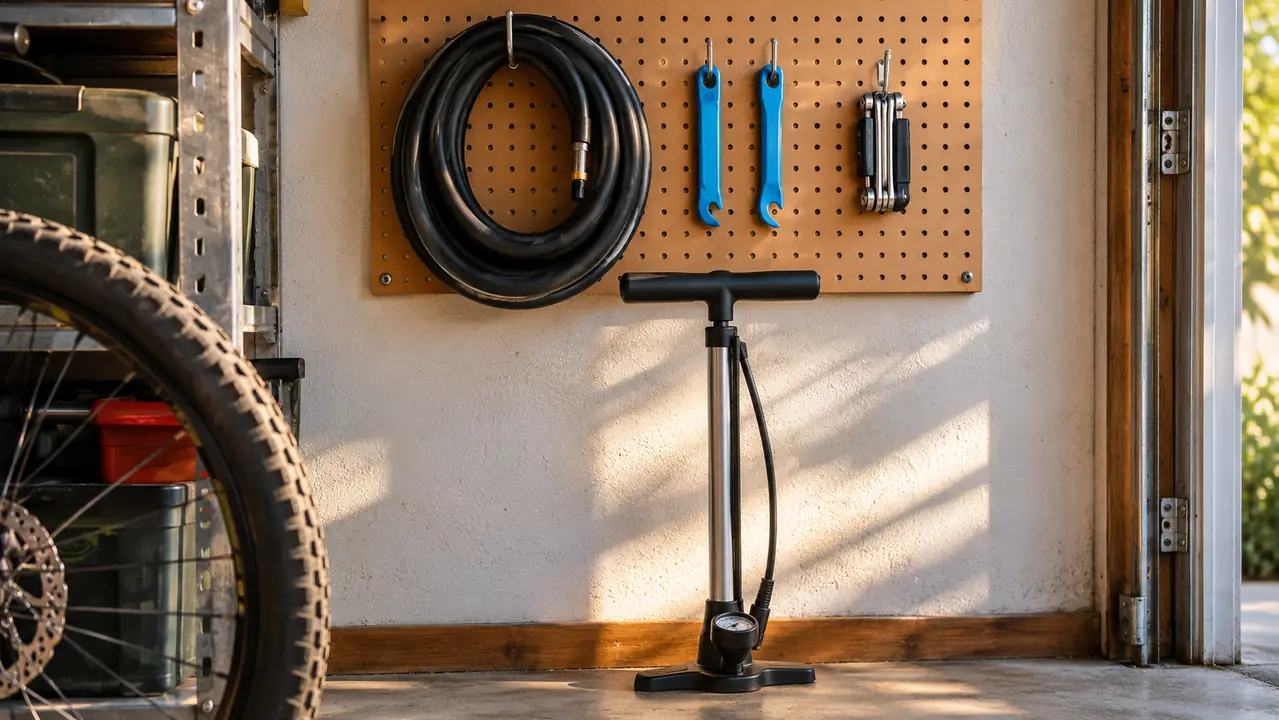
The rest of the bench has settled in around it. The multitool lives in the seat bag, the spare tube lives on the pegboard, and the pump lives against the wall by the bench leg where I can reach it without stepping over anything. Good tools end up with a place. Bad ones end up in a drawer.
Who This Is For
This pump suits a rider who keeps a bike in a garage or a shed, tops up before most rides, and wants a number instead of a thumb. It suits older hands, because the padded handle and the 27 inch standing height let you push down with your weight rather than squeeze with your fingers. And it suits anyone on Presta who is tired of screwing a head onto a valve and hoping it catches.
The Topeak also suits riders who run lower pressures on wider tires, as long as they accept the gauge as a guide rather than a laboratory instrument. I set 60 and 65 and I am content within a couple of psi of that. If you need exact, buy a separate digital gauge and use the pump to get close.
Who Should Skip It
Skip it if you want a digital readout, a stored target pressure, or a pump that packs into a car for a weekend away. Skip it if the bike lives in an apartment and you pump in a hallway, because 27 inches of pump is in the way in a hallway. Skip it if you already own a heavy floor pump that works and only the gauge is questionable, since a replacement gauge is a smaller errand than a new pump.
And skip it if you are the sort who yanks hoses. The base will lean, and it will be your own doing.
What I Liked
- 3 inch mid-barrel gauge is readable without glasses and sits at standing height
- TwinHead DX5 seats square on Presta and holds without a hand on it
- Oversized padded handle keeps hand fatigue down at 65 psi
- Alloy steel barrel and wide footprint stay put during normal pumping
- Extra long 360 degree hose reaches both wheels from one side of the bike
- Gauge still returns to zero after two years and roughly 8,000 miles
Where It Falls Short
- Analog only, and the useful 55 to 70 psi band is a thin slice of a 160 psi dial
- Base is light enough that the pump leans toward you if you yank the hose
- Head needs a firm, square push or it hisses at you
- 3.7 pounds and 27 inches tall, so it is garage furniture and never travels
- One year manufacturer warranty is short for a tool with this little to go wrong
- Ball and bladder heads included that most riders will never touch
Two tires I had been calling good were six and eight psi low. That is the whole case for a working gauge, and it cost me a pump to learn it.
Two years in, I would buy this one again
If your old pump's gauge quit and you have been guessing by thumb, this is the fix. Analog gauge, TwinHead DX5, padded handle, and a base that behaves as long as you do.
Amazon Check Today's Price on Amazon →